
Highest Minimum Wage Countries in Europe
Highest minimum wage countries in Europe often reflect the strength of a nation’s labour market, social protection policies, and economic productivity. Across the European Union, minimum wage systems are designed to ensure workers earn a baseline income that supports a reasonable standard of living.
Although minimum wage levels vary significantly across the continent, several European countries consistently rank among the highest due to strong economies and strict labour regulations. Countries such as Luxembourg, Ireland, Germany, and the Netherlands maintain some of the highest statutory minimum wages in Europe.
Understanding how minimum wages differ between countries is important for professionals evaluating job opportunities across the region. Our broader guide to salaries, cost of living and work-life balance in Europe explains how income, taxation, and employment conditions combine to shape overall financial wellbeing.
Which Country Has the Highest Minimum Wage in Europe?
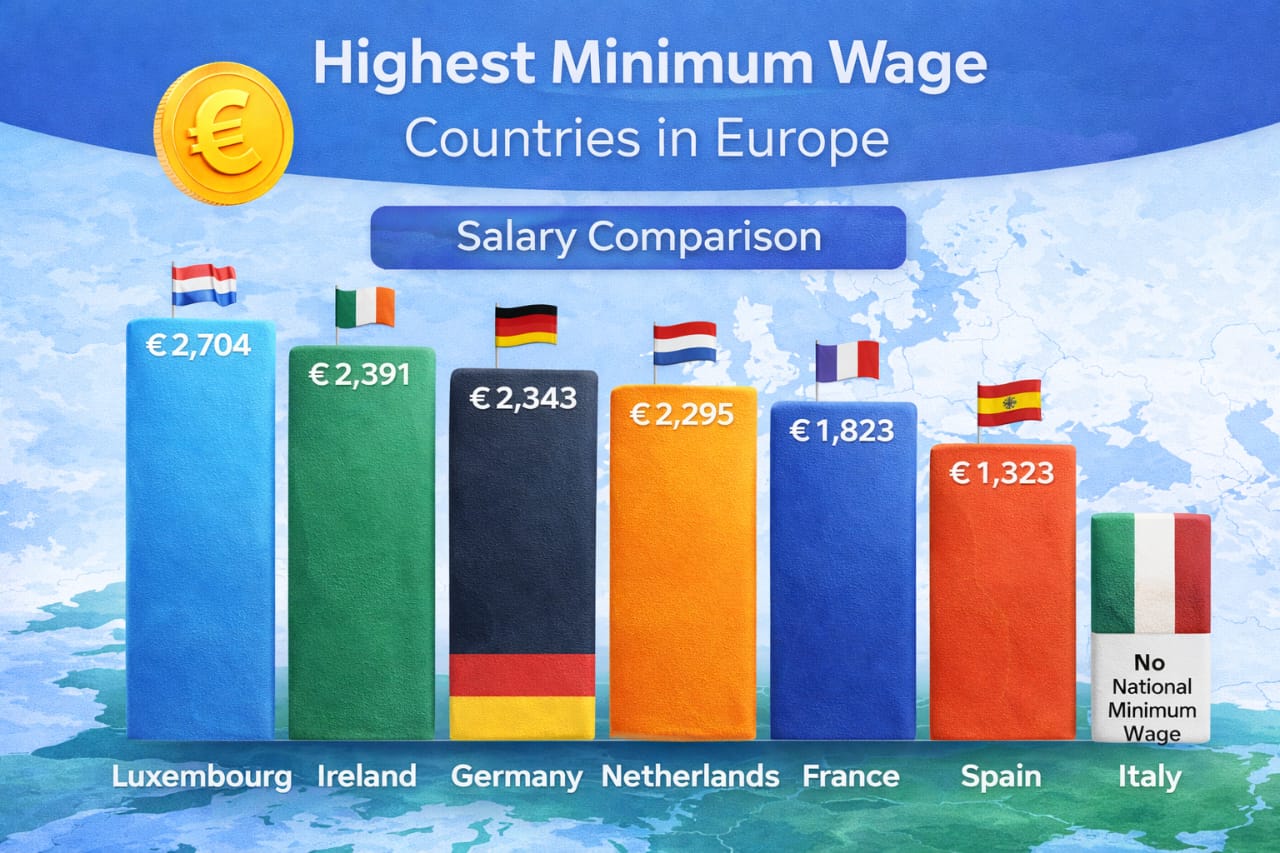
Luxembourg currently maintains the highest statutory minimum wage in Europe. As of 2026, the country’s national minimum wage exceeds €2,700 per month for full-time workers. This reflects Luxembourg’s strong financial sector and high living standards.
However, among the largest European economies, Ireland, Germany, and the Netherlands rank among the highest minimum wage countries in Europe. These nations combine relatively strong wage floors with robust labour protections.
Comparing wages across Europe also requires understanding how income translates into real purchasing power. Our detailed comparison of cost of living vs salary in Europe explains how living expenses influence disposable income.
Minimum Wage Comparison in Europe
| Country | Monthly Minimum Wage | Hourly Wage | National Minimum Wage |
|---|---|---|---|
| Luxembourg | ~€2,704 | ~€15+ | Yes |
| Ireland | ~€2,391 | €14.15 | Yes |
| Germany | ~€2,343 | €13.90 | Yes |
| Netherlands | ~€2,295 | ~€14.71 | Yes |
| France | ~€1,823 | €12.02 | Yes |
| Spain | ~€1,323 | ~€8.45 | Yes |
| Italy | No national minimum | N/A | No |
Minimum wage levels are periodically adjusted by national governments and may change as new wage policies are introduced.
This comparison shows that Northern and Western European countries generally maintain higher wage floors than Southern European economies.
Ireland
Ireland maintains one of the highest minimum wages among large European economies. As of 2026, the national minimum wage for workers aged 20 and above is approximately €14.15 per hour.
The Irish labour market is driven by multinational companies in technology, finance, and pharmaceuticals. Professionals considering relocation can explore employment conditions in our guide to working in Ireland.
Ireland also ranks highly in comparisons of the highest paying countries in Europe, reflecting strong salary levels across several industries.
Germany
Germany introduced a statutory national minimum wage in 2015 and has steadily increased it in recent years. In 2026, the German minimum wage stands at approximately €13.90 per hour.
The country’s labour market combines strong wage protections with high productivity, particularly in engineering, manufacturing, and technology sectors.
Professionals interested in the German labour market can read our detailed guide to working in Germany.
Germany’s income levels also appear prominently in our comparison of the average salary in Europe by country.
Netherlands
The Netherlands also ranks among the highest minimum wage countries in Europe. As of 2026, the national minimum wage for workers aged 21 and above is approximately €14.71 per hour.
The Dutch labour market is known for strong worker protections, flexible employment arrangements, and high productivity.
A detailed overview of employment conditions can be found in our guide to working in the Netherlands.
In addition to strong wages, the Netherlands is widely recognised for employee wellbeing. Our article on best work-life balance countries in Europe explains why the country consistently ranks highly.
France
France maintains a national minimum wage known as the “SMIC.” As of 2026, the minimum wage stands at approximately €12.02 per hour, equivalent to around €1,823 per month.
The French labour system emphasises worker protections and structured working hours, including the well-known 35-hour work week.
Professionals interested in employment conditions can learn more in our guide to working in France.
Spain
Spain’s national minimum wage has increased significantly in recent years. As of 2026, the statutory minimum wage is approximately €1,323 per month, often distributed across fourteen annual payments.
The Spanish labour market continues to expand in sectors such as tourism, renewable energy, and technology.
Professionals considering employment opportunities can explore our detailed guide to working in Spain.
Italy
Italy is one of the few European countries without a statutory national minimum wage. Instead, wages are regulated through sector-specific collective agreements negotiated between employers and labour unions.
These agreements determine minimum salary levels across industries such as manufacturing, construction, and services.
A detailed explanation of employment conditions can be found in our guide to working in Italy.
Minimum Wage and Taxation
Minimum wage alone does not determine how much income workers ultimately take home. Taxes and social contributions can significantly affect disposable earnings.
Our detailed guide to gross vs net salary in Europe explains how deductions influence real income across European countries.
Some countries also maintain relatively favourable income tax structures, which can improve disposable income even when headline wages appear lower. Our analysis of the lowest income tax countries in Europe explores these differences.
Labour Market Conditions Across Europe
Minimum wage policies are only one part of the broader European labour market. Employment conditions are also shaped by working hours, social protections, and employee benefits.
Our guide to working hours in Europe explains how labour laws regulate working time across EU countries.
European employees also benefit from extensive workplace protections. These include paid vacation, parental leave, and unemployment protections. Our overview of employee benefits in Europe explores these policies in detail.
For professionals evaluating career opportunities, sector demand can also influence income potential. Our analysis of high paying careers in Europe highlights industries with the strongest salary growth.
Choosing the Best Country to Work in Europe
While minimum wage levels provide an important benchmark, professionals evaluating employment opportunities should consider a wider range of factors. These include salary potential, taxation systems, working hours, and overall quality of life.
Our guide to the best countries to work in Europe for foreign professionals compares labour markets across the continent.
Understanding how wage policies fit within national tax systems is also important. Our analysis of European tax systems explained provides additional context.
Conclusion
The highest minimum wage countries in Europe are typically found in Western and Northern Europe, where strong labour protections and high productivity support higher wage floors.
Luxembourg currently holds the highest statutory minimum wage in Europe, while Ireland, Germany, and the Netherlands maintain the highest minimum wages among the continent’s largest economies.
However, professionals comparing employment opportunities should consider more than just minimum wage levels. Salary potential, taxation systems, and living costs all play an important role in determining real income and overall financial wellbeing.