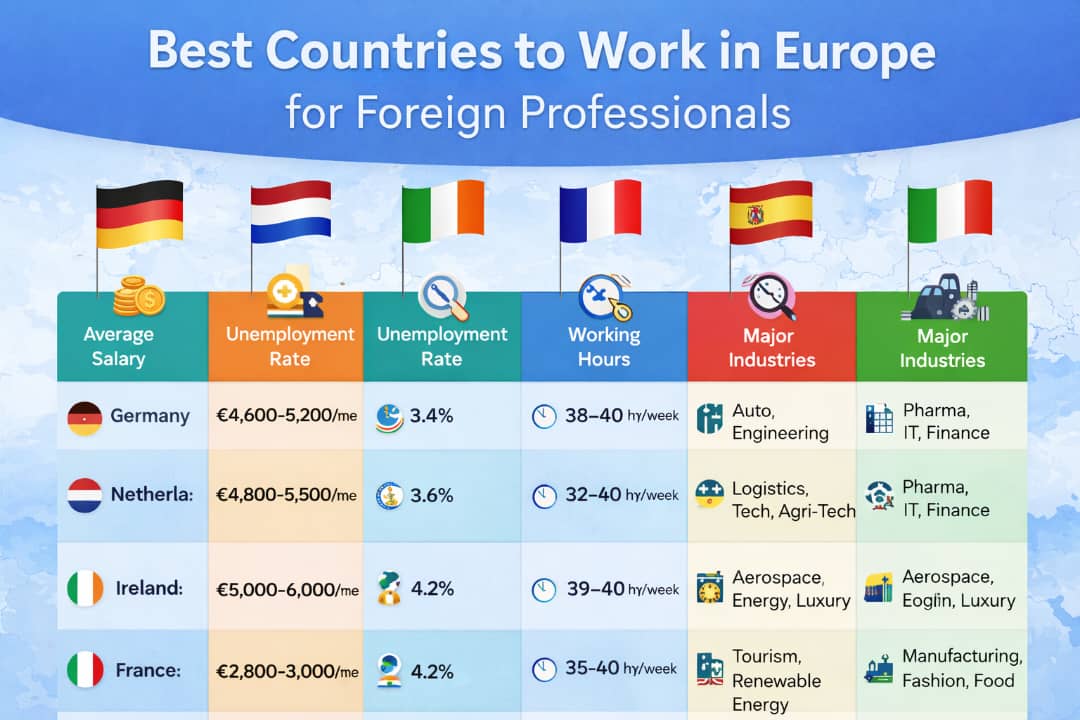

Best Countries to Work in Europe for Foreign Professionals
Best countries to work in Europe for foreign professionals are often identified by a combination of strong job markets, competitive salaries, stable economies, and supportive work-life policies. Across the European Union, several countries consistently attract international talent due to their employment opportunities, labour protections, and high quality of life.
For professionals considering relocation, factors such as salary levels, taxation systems, job demand, working hours, and employee benefits all play an important role in determining where opportunities are strongest. Countries such as Germany, the Netherlands, Ireland, France, Spain, and Italy are among the most frequently considered destinations for skilled workers moving to Europe.
Understanding how salaries, working conditions, and labour market trends differ across these economies is essential for anyone evaluating long-term employment prospects in Europe.
For a broader overview of compensation structures across the region, see our detailed guide to salaries, cost of living and work-life balance in Europe.
Which Countries Are Best for Foreign Professionals in Europe?
Among the major European economies, Germany, the Netherlands, and Ireland are often considered some of the best countries to work in Europe for foreign professionals. These countries offer strong labour markets, competitive salaries, and significant demand for skilled international workers. France, Spain, and Italy also attract professionals due to large economies, strong worker protections, and diverse career opportunities.
European Labour Market Overview
The European labour market has remained relatively stable in recent years, with several major economies reporting strong employment levels and continued demand for skilled professionals. Technology, engineering, healthcare, finance, and logistics remain among the fastest-growing sectors across many European countries.
However, comparing job opportunities between countries requires more than simply looking at gross salary figures. Tax systems, social security contributions, and living costs can significantly influence the real value of earnings.
For example, professionals often compare their earnings by understanding the difference between gross vs net salary in Europe, which determines the final take-home pay after taxes and contributions.

Key Factors That Make a Country Attractive for Foreign Professionals
Several factors influence why international professionals choose certain European countries over others.
Salary competitiveness is one of the most obvious factors. Countries with stronger economies generally offer higher wages and better career progression opportunities. A detailed comparison can be found in our analysis of the highest paying countries in Europe.
Cost of living also plays a critical role. A higher salary does not always guarantee stronger purchasing power if housing and daily expenses are significantly higher. Professionals evaluating relocation often compare cost of living vs salary in Europe to understand real income differences.
Labour protections and benefits are another important factor. European labour markets typically offer strong employee rights, including paid leave, healthcare coverage, and social security protections. Our guide to employee benefits in Europe explains how these protections vary between countries.
Finally, working hours and work-life balance influence long-term job satisfaction. The average work week varies across countries, and professionals may prefer economies with shorter hours and stronger labour protections. Learn more in our guide to working hours in Europe.
Germany
Germany remains one of the most attractive destinations for skilled professionals moving to Europe. The country has the largest economy in the European Union and a strong demand for workers in sectors such as engineering, manufacturing, automotive technology, healthcare, and information technology.
Professionals working in Germany typically benefit from competitive salaries, strong labour protections, and a well-structured social security system. Detailed information about employment conditions can be found in our guide to working in Germany.
Germany also maintains one of the lowest unemployment rates among major EU economies, making it a consistent destination for international workers seeking long-term career stability.
Netherlands
The Netherlands is widely recognised for its strong work-life balance, international business environment, and high demand for skilled workers. Cities such as Amsterdam, Rotterdam, and Eindhoven host numerous multinational companies and technology firms.
The Dutch labour market offers competitive salaries and a strong professional culture that supports flexible working arrangements and international talent recruitment. For a detailed breakdown of salary structures, taxes, and employment conditions, see our guide to working in the Netherlands.
The Netherlands also ranks highly for overall quality of life, combining strong wages with progressive labour policies and relatively moderate working hours.
Ireland
Ireland has become one of Europe’s fastest-growing economies and a major hub for technology, pharmaceutical, and financial services companies. Global corporations such as Google, Apple, Meta, and Microsoft maintain significant European operations in the country.
High-skilled professionals working in Ireland often earn competitive salaries, particularly in the technology and finance sectors. Dublin in particular has developed into one of Europe’s most important international business centres.
For more information about employment conditions and taxation systems, see our guide to working in Ireland.
France
France offers a large and diverse labour market with opportunities in industries such as aerospace, energy, luxury manufacturing, and finance. The country is also known for strong labour protections, including legally regulated working hours and generous paid leave policies.
While average salaries may be slightly lower than in some Northern European economies, France provides comprehensive social protections and high living standards. Our guide to working in France explains how salary structures and taxation work for professionals relocating to the country.
Spain
Spain has become an increasingly popular destination for international professionals, particularly those working remotely or in technology and renewable energy sectors. The country offers a strong quality of life, favourable climate, and growing digital economy.
While salaries are generally lower than in Northern Europe, living costs can also be significantly lower depending on the city or region. For a detailed overview of employment conditions and taxation systems, see our guide to working in Spain.
Italy
Italy remains one of Europe’s largest economies and offers employment opportunities across sectors such as manufacturing, fashion, automotive engineering, and food production.
Although the country does not maintain a statutory national minimum wage, wages are typically determined through sector-specific collective agreements. Our guide to working in Italy explains how salary structures and labour agreements operate across different industries.
Major economic centres such as Milan, Turin, and Bologna continue to attract professionals working in finance, technology, and design.
Average Salary Levels Across Europe
Salary levels across European countries vary significantly depending on economic productivity, industry specialization, and labour market demand.
A useful comparison of earnings across the region can be found in our analysis of the average salary in Europe by country. This comparison highlights how income levels differ between major economies such as Germany, France, Ireland, Spain, and the Netherlands.
Professionals seeking higher earnings may also explore industries with stronger compensation levels. Our guide to high paying careers in Europe outlines sectors with the strongest salary potential.
Understanding European Tax Systems
Taxation is another important factor when evaluating job opportunities across Europe. Even countries with similar gross salary levels can produce different take-home pay due to variations in income tax rates and social contributions.
Our detailed guide to European tax systems explains how these systems differ between countries and how they influence net income.
Professionals seeking lower tax environments may also explore countries with relatively favourable income tax structures. See our analysis of the lowest income tax countries in Europe for further insights.
Minimum Wage Policies Across Europe
Minimum wage laws vary across the European Union. While many countries maintain statutory national minimum wages, others rely on sector-specific collective agreements negotiated between employers and labour unions.
For a full comparison of statutory wage policies across EU countries, see our guide to minimum wage in Europe.
Conclusion
The best countries to work in Europe for foreign professionals depend on a combination of factors including salary potential, job demand, taxation systems, and quality of life.
Germany, the Netherlands, Ireland, France, Spain, and Italy all offer unique advantages for international workers. While Northern European economies often provide higher salaries, Southern European countries may offer lower living costs and attractive lifestyle benefits.
Professionals considering relocation to Europe should evaluate employment opportunities carefully by comparing salary levels, labour protections, and cost-of-living conditions across different countries before making a long-term career decision.
Other European countries such as Denmark, Sweden, and Switzerland also attract international professionals due to high salaries and strong labour protections, although employment requirements and language expectations may vary.