
Best Work-Life Balance Countries in Europe
Best work-life balance countries in Europe consistently attract professionals who want strong labour protections, flexible working hours, and generous paid leave policies. Across the European Union, work-life balance is influenced by several factors including average weekly working hours, statutory vacation entitlements, parental leave policies, remote work adoption, and labour laws that protect personal time outside work.
Many European economies prioritise employee wellbeing through shorter working weeks, mandatory paid leave, and social protections. For professionals considering employment in Europe, understanding how work culture differs between countries can be just as important as comparing salaries or taxation systems.
A broader overview of employment conditions across the region can be found in our guide to salaries, cost of living and work-life balance in Europe, which explains how compensation, living costs, and working hours interact across different European labour markets.
What Determines Work-Life Balance in Europe?
Work-life balance is shaped by several structural factors within a country’s labour market. While salary levels often attract attention, employee wellbeing is strongly influenced by working hours, vacation time, labour protections, and workplace flexibility.
One of the most important indicators is the average number of hours employees work each week. European countries typically maintain shorter working weeks than many other advanced economies. A detailed comparison of national standards can be found in our guide to working hours in Europe.
Paid vacation policies also play a major role. European labour laws require employers to provide a minimum number of paid leave days, often supplemented by public holidays and additional benefits negotiated through collective agreements. Our overview of employee benefits in Europe explains how these protections vary between countries.
Another factor is taxation and take-home pay. Even if working hours are shorter, disposable income can vary significantly depending on national tax systems and social security contributions. A detailed breakdown can be found in our guide to European tax systems explained.
Which Countries Have the Best Work-Life Balance in Europe?
Among the major European economies, the Netherlands, Germany, Ireland, and France are often considered some of the best work-life balance countries in Europe. These countries combine moderate working hours, strong labour protections, and generous paid leave policies.
Spain and Italy also provide attractive work-life conditions, particularly due to longer vacation entitlements and strong cultural emphasis on personal time and family life.
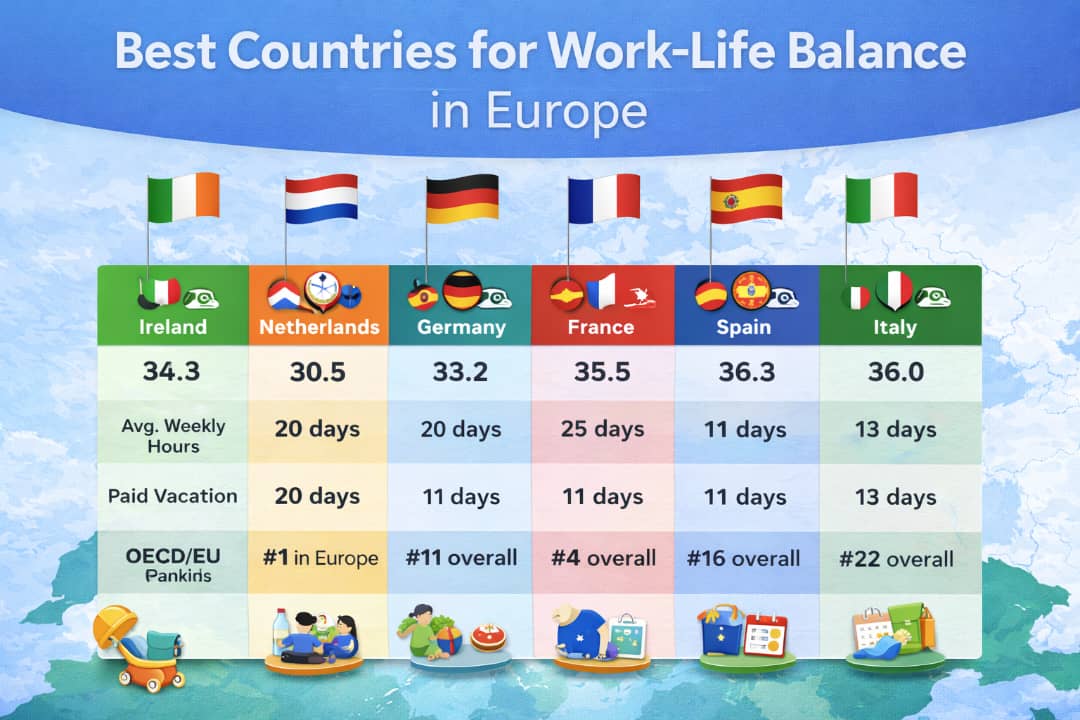
Work-Life Balance Comparison in Major European Economies
| Country | Average Weekly Hours | Minimum Paid Vacation | Public Holidays |
|---|---|---|---|
| Ireland | 34.3 hours | 20 days | 10 days |
| Netherlands | 30.5 hours | 20 days | 11 days |
| Germany | 33.2 hours | 20 days | 9–13 days |
| France | 35.5 hours | 25 days | 11 days |
| Spain | 36.3 hours | 23 days | 14 days |
| Italy | 36.0 hours | 22 days | 13 days |
These indicators illustrate how labour policies differ across Europe. While Northern European economies often emphasise shorter working weeks and flexible employment structures, Southern European countries tend to combine moderate working hours with strong vacation entitlements and cultural emphasis on leisure time.
Netherlands
The Netherlands consistently ranks among the strongest countries in Europe for work-life balance. Dutch employees work one of the shortest average working weeks in the European Union, partly due to widespread part-time employment and flexible working arrangements.
Many professionals choose the Netherlands not only for employment opportunities but also for lifestyle flexibility. The country’s labour market also attracts international talent seeking strong compensation combined with balanced working conditions. Our detailed guide to working in the Netherlands explains how salary structures and employment regulations operate.
Ireland
Ireland has become one of Europe’s most dynamic economies and offers a strong combination of career opportunities and flexible work arrangements. The country has experienced significant growth in sectors such as technology, pharmaceuticals, and financial services.
Hybrid work adoption is particularly high, with many multinational companies offering flexible working arrangements. Professionals interested in employment opportunities can explore our detailed guide to working in Ireland.
Income potential in Ireland is also relatively strong compared with many European countries. This is reflected in our comparison of the highest paying countries in Europe, where Ireland consistently ranks near the top.
Germany
Germany combines strong labour protections with a highly productive economy. The country maintains strict labour laws regulating working hours, overtime, and employee protections.
Germany is also known for flexible parental leave policies, allowing parents extended time away from work through the “Elternzeit” system. Professionals considering employment in the country can learn more in our guide to working in Germany.
For many professionals, Germany offers a balanced mix of income potential and social protection. Comparisons of earnings across major European economies can be found in our analysis of the average salary in Europe by country.
France
France is widely recognised for its strong labour protections and structured working hours. The country maintains a statutory 35-hour work week, one of the shortest legal working weeks among major economies.
Employees are also entitled to generous paid leave, including five weeks of annual vacation in addition to public holidays. Labour laws such as the “right to disconnect” further protect employees from work communications outside official working hours.
Our detailed guide to working in France explains how salary structures, labour laws, and employment protections operate.
Spain
Spain offers a distinctive approach to work-life balance that combines moderate working hours with generous vacation time and strong cultural emphasis on leisure. The country also offers competitive opportunities in sectors such as tourism, renewable energy, and digital technology.
Professionals interested in employment opportunities can explore our detailed guide to working in Spain.
While salary levels are generally lower than in Northern Europe, overall purchasing power can vary depending on housing costs and taxation systems. A deeper comparison can be found in our analysis of cost of living vs salary in Europe.
Italy
Italy combines a strong cultural emphasis on family life with labour protections that support extended vacation and parental leave policies. Although the country does not maintain a statutory national minimum wage, sector-specific collective agreements regulate wages and working conditions.
Professionals considering employment in the country can learn more about labour regulations in our guide to working in Italy.
Italy’s labour market offers opportunities in industries such as manufacturing, design, food production, and luxury fashion, which are also highlighted in our overview of high paying careers in Europe.
Remote Work and Modern Work Culture
Remote work adoption has increased significantly across Europe in recent years. The Netherlands and Ireland in particular have experienced strong growth in hybrid and remote working models, allowing employees greater flexibility in managing their professional and personal lives.
These changes have influenced how professionals evaluate employment opportunities. Instead of focusing solely on salary levels, many workers now consider lifestyle factors such as working hours, job flexibility, and labour protections.
Understanding how salary translates into take-home income is also important. Our guide to gross vs net salary in Europe explains how taxes and social contributions affect real earnings.
Minimum Wage and Social Protection
Many European countries maintain statutory minimum wages designed to ensure a baseline standard of living for workers. However, minimum wage systems vary significantly between countries.
Our guide to minimum wage in Europe explains how these wage policies differ across EU member states.
Some countries also maintain relatively favourable income tax structures, which can improve disposable income even when headline salaries appear lower. Our analysis of the lowest income tax countries in Europe explores these differences.
Choosing the Right Country to Work in Europe
Choosing the best country to work in Europe depends on a variety of factors including career opportunities, salary levels, taxation systems, and lifestyle preferences.
Professionals seeking both strong employment prospects and balanced working conditions often compare multiple factors before relocating. Our guide to the best countries to work in Europe for foreign professionals explores how these elements combine across different labour markets.
Conclusion
The best work-life balance countries in Europe combine moderate working hours, generous vacation policies, and strong labour protections that support employee wellbeing.
Countries such as the Netherlands, Ireland, Germany, and France frequently rank among the strongest performers due to their structured labour policies and flexible work arrangements. Spain and Italy also offer attractive lifestyles supported by generous vacation entitlements and cultural emphasis on personal time.
Professionals evaluating employment opportunities in Europe should consider a range of factors including salary potential, working hours, taxation systems, and overall quality of life before deciding which country best suits their long-term career goals.
As labour markets evolve and remote work expands, work-life balance is becoming an increasingly important factor for professionals choosing where to live and work in Europe