


Direct Answer: Cost of living vs salary in Europe determines real savings potential more than gross income levels. High-paying cities such as Zurich and Copenhagen often have elevated housing and daily expenses, while cities like Berlin, Lisbon, or Warsaw may offer stronger salary-to-cost ratios. Net disposable income after rent, tax, and essential expenses is the true measure of financial advantage.
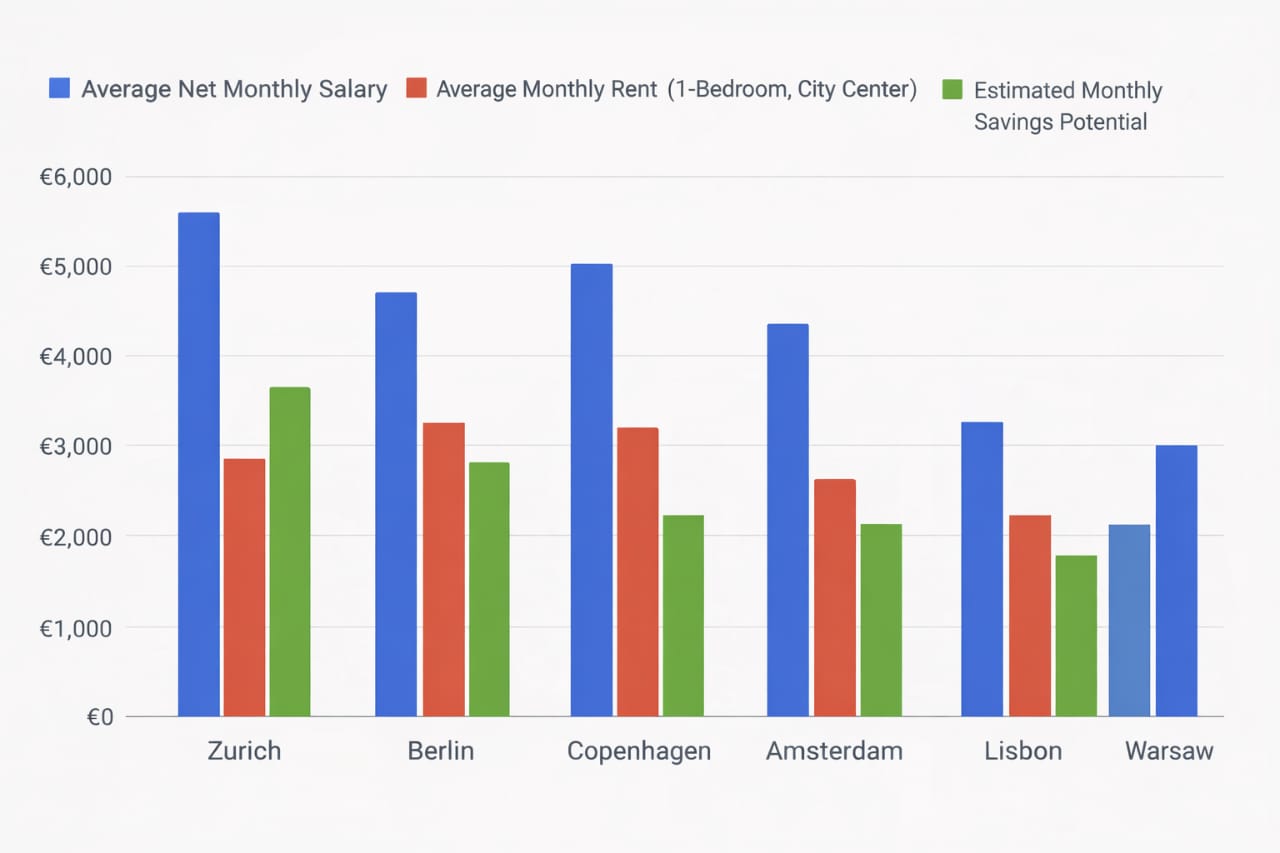
Cost of living vs salary in Europe is the most important comparison professionals should make before relocating. Gross income may appear competitive on paper, but purchasing power is shaped by rent levels, taxation, utility costs, transport systems, and social contributions.
Across Europe, economic structures vary significantly. Northern and Western European countries typically offer higher salaries. However, these higher incomes often reflect stronger consumer price levels and elevated housing markets. Southern and Eastern Europe frequently present lower average wages but also reduced living costs.
The objective is not simply to secure the highest salary. The objective is to maximise sustainable savings while maintaining financial stability.
How Should Professionals Measure Savings Potential?
Savings potential depends on disposable income rather than gross earnings. A structured comparison should include:
- Net monthly salary after income tax and social contributions
- Average rent for a one-bedroom apartment
- Utility and energy expenses
- Public transportation costs
- Food and insurance expenses
- Mandatory pension or healthcare contributions
European taxation systems are generally progressive, meaning take-home income can differ substantially from contract salary. Social contributions finance public healthcare and pension frameworks, reducing certain private expenses.
For a broader understanding of how income, taxation, and work-life balance operate together, see our main guide on Salaries, Cost of Living & Work-Life Balance in Europe.
City Comparison: High Salary vs High Costs
Zurich
Zurich frequently ranks among Europe’s highest-paying cities in international wage and cost-of-living comparisons. However, rental costs, consumer goods, insurance premiums, and service prices align with that income level. While professionals may earn substantially, housing can consume a significant portion of monthly net income.
Copenhagen
Copenhagen offers strong wages alongside comprehensive social benefits. Income tax rates are comparatively higher, but public healthcare, parental support, and social security systems are robust. Disposable income depends heavily on housing location and lifestyle choices.
Amsterdam
Amsterdam maintains competitive salaries, particularly in technology and multinational sectors. However, the rental market remains tight, increasing pressure on monthly budgets. Many professionals working in Amsterdam evaluate surrounding cities to improve their savings ratio.
City Comparison: Moderate Salary, Balanced Costs
Berlin
Berlin provides moderate salaries relative to Western Europe but lower housing costs compared to Zurich or Amsterdam. Germany’s stable labor framework, collective bargaining systems, and structured working regulations contribute to predictable employment conditions.
Lisbon
Lisbon attracts international professionals due to lifestyle appeal and growing technology sectors. Salaries remain lower than Northern Europe, but daily expenses and rental markets are often comparatively manageable outside central districts.
Warsaw
Warsaw illustrates how lower average wages can still support reasonable living standards when housing and services remain affordable. Expanding finance and technology sectors have strengthened earning potential.

Which European Cities Let You Save More?
The cities that allow professionals to save more are not always those with the highest gross salaries. Savings improve when:
- Rent consumes less than 30–35% of net income
- Public healthcare reduces private insurance costs
- Public transportation lowers commuting expenses
- Tax structures align with income bracket
In many cases, mid-tier cities outperform financial hubs in percentage savings potential. Secondary Dutch cities may outperform Amsterdam in disposable income ratios. German cities outside Munich can present stronger purchasing power balance. Comparable patterns appear across Central Europe.
This reinforces a key principle: purchasing power is more relevant than nominal income.
How Taxes Influence Real Savings
Tax frameworks significantly shape disposable income across Europe. Higher marginal tax rates are often paired with structured welfare systems including public healthcare and pension contributions.
When evaluating offers, professionals should focus on effective tax rate rather than headline deduction percentages. Disposable income after taxation and housing expenses offers the clearest financial indicator.
Housing Markets: The Largest Expense Variable
Housing typically represents the largest recurring expense in European cities. Rental availability, urban demand, and supply constraints strongly influence cost levels.
Professionals often improve savings potential by:
- Living outside high-demand city centres
- Utilising efficient public transport networks
- Considering shared housing temporarily
- Negotiating relocation or housing support
Strategic housing decisions frequently determine savings capacity more than salary increases.
Purchasing Power vs Nominal Salary
Purchasing power reflects how much income can buy locally. High-cost urban centres reduce effective purchasing power even when salaries appear strong. Balanced cities with moderate wages and stable expenses often provide stronger long-term savings ratios.
Economic stability, inflation exposure, and housing dynamics all influence purchasing power outcomes.
Is Moving to a High-Paying City Always the Right Choice?
Not necessarily.
High-paying cities often bring elevated living standards but also increased financial pressure. Balanced markets may allow steady savings growth with less housing competition and more stable monthly expenses.
The most suitable choice depends on:
- Career growth opportunities
- Industry demand
- Personal lifestyle priorities
- Family structure
- Long-term financial goals
Final Evaluation
Cost of living vs salary in Europe should be assessed as a complete equation rather than a headline comparison. Net income, rental burden, taxation structure, and public benefits together determine actual savings potential.
In many cases, the cities that allow higher long-term savings are not those with the highest salaries, but those where income, rent, and taxation remain proportionate.