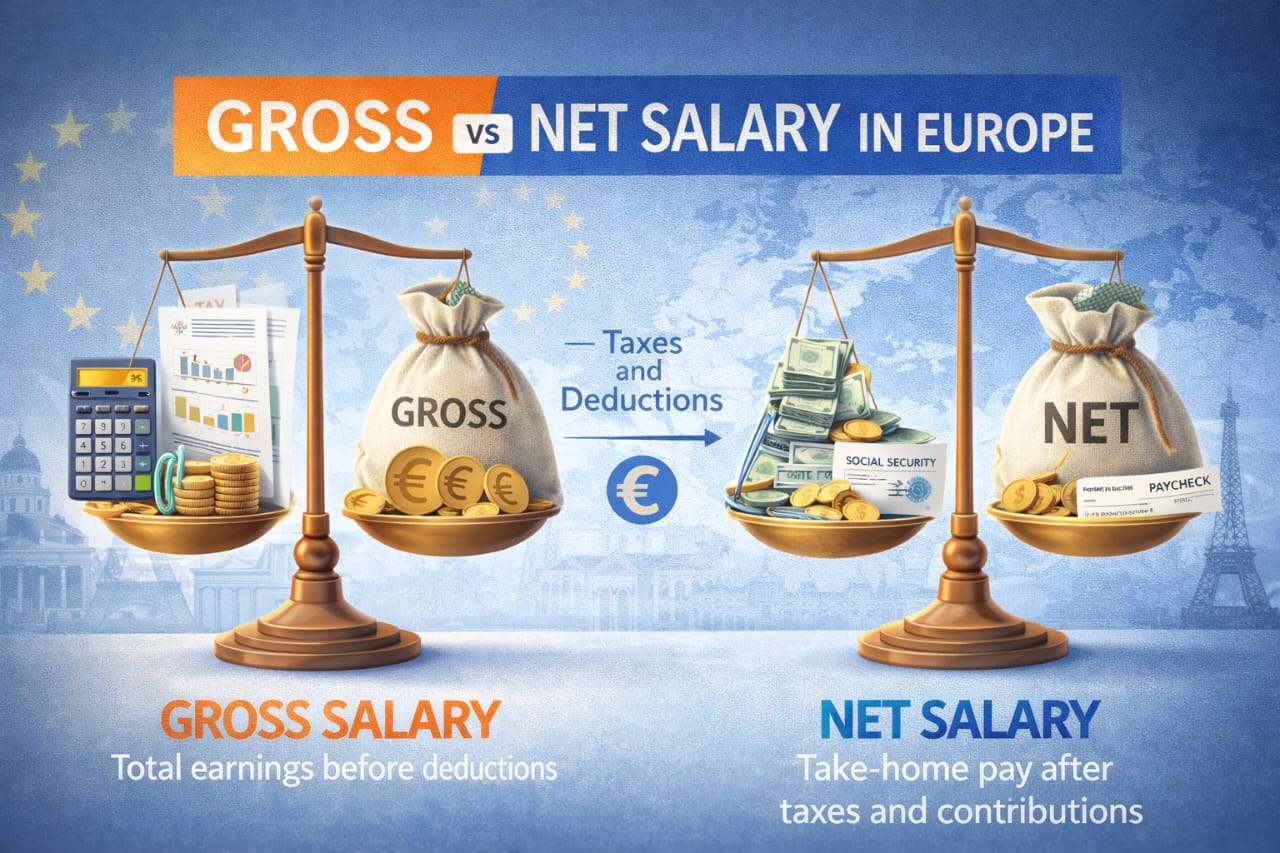

Gross vs Net Salary in Europe is one of the most important financial distinctions professionals must understand when evaluating employment opportunities across EU countries. A job offer may advertise an attractive annual figure, yet the amount that actually reaches your bank account can differ dramatically once income taxes and statutory social contributions are applied.
This guide provides a structured, harmonised explanation of how gross salary converts into net pay across major European economies. It also explains why two identical salaries in different countries can produce significantly different take-home outcomes.
Methodology and Data Consistency
All average salary figures referenced in this article are based on Eurostat’s dataset for average annual gross earnings of full-time employees, using the latest available harmonised full-year statistical release.
This ensures:
- Consistent definition of earnings across countries
- Full-time employees only
- No mixing of part-time or temporary employment data
- Unified statistical methodology
Tax brackets and contribution percentages reflect current statutory frameworks at the time of writing. Salary statistics are based on the most recently published full-year release under Eurostat methodology. Tax and contribution rates may be updated periodically by national legislatures.
What Is Gross Salary?
Gross salary is the total contractual earnings agreed between employer and employee before any deductions. It is the figure typically displayed in job advertisements and employment contracts.
Gross salary may include:
- Base annual salary
- Fixed contractual bonuses
- Allowance components
It does not reflect income tax, pension contributions, unemployment insurance, or statutory health contributions.
What Is Net Salary?
Net salary — often referred to as take-home pay — is the amount that remains after all mandatory deductions have been applied.
These deductions generally include:
- Personal income tax
- Employee pension contributions
- Health insurance contributions
- Unemployment insurance
- Long-term care insurance (in some systems)
- Regional or municipal surcharges
The difference between gross and net income can range from 20% to over 45% depending on country and salary level.
The Gross-to-Net Formula
Although each EU country applies its own fiscal structure, the simplified equation remains broadly consistent:
Gross Salary – Income Tax – Employee Social Contributions – Mandatory Charges = Net Salary
However, the complexity lies in:
- Progressive tax bands
- Tax-free allowances
- Integration of insurance into tax rates
- Regional levies
- Family tax credits

Country-by-Country Structure
Germany
Average Annual Gross Earnings: €51,657
Germany applies progressive income taxation following a tax-free basic allowance. The marginal tax rate increases gradually, reaching up to 45% at high income levels.
Employee social contributions typically total around 20% of gross salary and include:
- Pension insurance
- Statutory health insurance
- Unemployment insurance
- Long-term care insurance
This structure can result in a substantial gap between gross and net income at mid-level salary bands.
Detailed analysis available in Working in Germany.
France
Average Annual Gross Earnings: €43,790
France combines progressive income tax with social contributions. While employer contributions are notably high, employee contributions also reduce take-home pay meaningfully.
Healthcare and pension financing is heavily payroll-based.
See Working in France for detailed breakdown.
Netherlands
Average Annual Gross Earnings: €53,791
The Netherlands operates the Box 1 tax system, where income tax and national insurance contributions are integrated into bracketed rates.
Higher earners may face marginal rates nearing 49.5%. The country also provides specific expatriate tax incentives under defined eligibility criteria.
Full overview in Working in the Netherlands.
Ireland
Average Annual Gross Earnings: €61,100
Ireland applies a two-band income tax model (standard and higher rate) combined with PRSI and the Universal Social Charge (USC). The layered structure produces progressive effective rates.
Breakdown available in Working in Ireland.
Spain
Average Annual Gross Earnings: €33,700
Spain’s IRPF combines state and autonomous community taxation. Regional location affects final effective tax rate.
Social security contributions generally fall around 6–7% for employees.
More information in Working in Spain.
Italy
Average Annual Gross Earnings: €33,523
Italy applies progressive IRPEF taxation with additional regional and municipal add-ons. Employee INPS contributions typically range between 9% and 10%.
Marginal vs Effective Tax Rates
One common misconception in salary comparison is confusing marginal tax rates with effective tax rates.
Marginal tax rate refers to the highest rate applied to the last portion of income earned.
Effective tax rate represents the average percentage of total income paid in taxes.
Two individuals in the same country may face the same marginal rate but have different effective rates depending on deductions and allowances.
Employer Cost vs Employee Income
Gross salary is not the total cost of employment for employers. In many EU countries, employers pay additional payroll contributions.
For example:
- France and Italy have high employer contribution levels
- Germany applies matched pension and insurance contributions
- Netherlands integrates social components differently
This distinction explains why employer-side costs can be significantly higher than employee take-home income.
Gross vs Net and Purchasing Power
Net salary must be evaluated alongside living costs. A lower gross salary in one country may still provide stronger purchasing power due to housing, transport or food price differences.
Structured comparison available in Cost of Living vs Salary in Europe.
Working Time and Benefits Also Matter
Income cannot be evaluated independently of work-life balance and statutory benefits.
Comprehensive overview available in Salaries, Cost of Living and Work-Life Balance in Europe.
Frequently Asked Questions
Is gross salary the same across Europe?
No. Gross salary levels differ substantially between Northern and Southern Europe based on economic productivity, sector concentration and labour market structure.
Which country has the highest net salary?
Net salary depends on income level and household structure. High gross salary countries often have higher taxation, while lower tax countries may provide fewer public services.
Why are deductions higher in some countries?
Countries with broader public healthcare, pension guarantees and unemployment systems typically finance these through payroll-based contributions.
Final Perspective
Gross vs net salary in Europe should be analysed within statutory frameworks, social insurance systems and cost-of-living environments. Harmonised Eurostat data provides a reliable basis for gross earnings comparison, but net outcomes depend on tax policy, contribution structure and individual circumstances.
Tax brackets, social contribution rates and fiscal regulations may change through national legislative processes. Professionals should confirm official sources before making financial decisions.