
Highest Paying Countries in Europe (Average Salary Comparison)
Highest paying countries in Europe attract global professionals seeking better salaries, career development, and strong labour protections. While many European economies offer competitive wages and comprehensive social benefits, salary levels differ significantly depending on economic productivity, industry demand, and national labour policies.
[22:52, 14/03/2026] Micky:Professionals considering relocation often explore country-specific employment conditions such as salaries, taxation, and living costs. A detailed breakdown can be found in the guide to working in France salary taxes and cost of living.
[22:55, 14/03/2026] Micky:Professionals comparing high-income careers across Europe often examine country-specific opportunities. A detailed guide explains highest paying jobs in France and the professions that offer the strongest salaries in the French job market.
Many professionals researching salary levels across Europe also want to understand which careers offer the highest income potential. A detailed guide explores highest paying jobs in Ireland and the industries where professionals earn some of the strongest salaries in the Irish labour market.
Many professionals researching the highest paying countries in Europe focus primarily on average salary levels, but income alone does not always reflect real purchasing power. Taxation systems, living costs, working hours, and employee benefits all influence the financial reality of working in different European countries.
This guide compares average salaries across major European economies using harmonised statistical data. The analysis focuses on six large labour markets — Ireland, the Netherlands, Germany, France, Spain, and Italy — which together represent some of the most widely studied employment destinations for international professionals.
Professionals considering relocation should also understand how salaries interact with living expenses and lifestyle factors. A broader overview is available in the guide to salaries, cost of living, and work-life balance in Europe.
How Average Salaries Are Measured Across Europe
Comparing salaries across countries can easily become misleading if different statistical definitions are used. Some datasets measure median income, others measure household earnings, and some combine part-time and full-time employment.
To ensure accuracy, this comparison uses the Eurostat harmonised dataset for average annual gross earnings of full-time employees. This dataset applies a consistent statistical methodology across EU member states, allowing meaningful comparisons between national labour markets.
Salary statistics are based on the latest harmonised Eurostat full-year releases available at the time of writing and may be updated as new statistical data becomes available.
Highest Paying Countries in Europe (Average Salary Comparison)
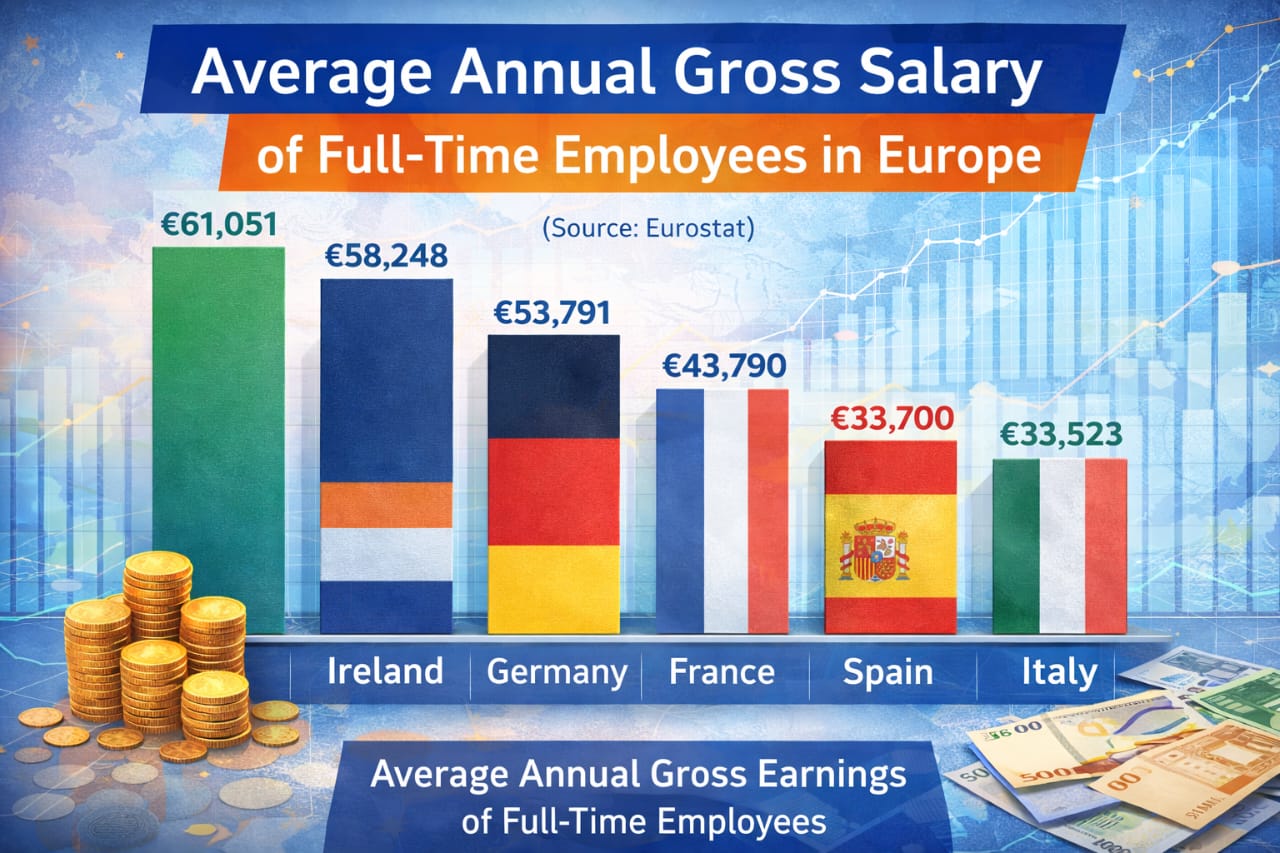
Based on Eurostat’s harmonised dataset for average annual gross earnings of full-time employees, the following countries rank among the highest paying labour markets in Europe.
- Ireland – €61,051 average annual salary
- Netherlands – €58,248 average annual salary
- Germany – €53,791 average annual salary
- France – €43,790 average annual salary
- Spain – €33,700 average annual salary
- Italy – €33,523 average annual salary
| Country | Average Annual Salary |
|---|---|
| Ireland | €61,051 |
| Netherlands | €58,248 |
| Germany | €53,791 |
| France | €43,790 |
| Spain | €33,700 |
| Italy | €33,523 |
Which Country Pays the Highest Salary in Europe?
Among the major European economies analysed in this guide, Ireland currently records the highest average salary for full-time employees based on Eurostat data, followed by the Netherlands and Germany.
Ireland
Ireland currently ranks among the highest paying countries in Europe, with average full-time earnings exceeding €61,000 annually. High salaries are largely driven by multinational technology companies, pharmaceutical firms, and international financial services operating in Dublin and other major cities.
Professionals considering relocation should review the detailed employment guide to working in Ireland to understand taxation systems, living costs, and salary structures.
Netherlands
The Netherlands maintains one of the highest average salaries in Europe, supported by a strong international trade sector, advanced logistics infrastructure, and a rapidly expanding technology industry.
Professionals can explore the labour market structure in the guide to working in the Netherlands.
Dutch labour policies also emphasise flexible working arrangements and balanced working hours, which are explored further in the article on working hours in Europe.
Germany
Germany remains Europe’s largest industrial economy and one of its highest paying labour markets. Strong manufacturing sectors, engineering expertise, and export-driven industries contribute to average annual earnings exceeding €53,000.
The German labour system also provides extensive social insurance coverage. A full overview is available in the guide to working in Germany.
France
France combines a diverse economic structure with strong worker protections. While salaries are slightly lower than northern European economies, the country maintains significant employment opportunities in aerospace, finance, luxury manufacturing, and tourism.
Readers interested in the French employment system can explore the detailed guide to working in France.
France also offers extensive labour protections and welfare systems explained in the article on employee benefits in Europe.
Spain
Spain records an average annual salary of approximately €33,700 according to Eurostat data. Although wages are lower than northern European economies, Spain attracts professionals due to lifestyle factors and expanding digital sectors.
More information is available in the guide to working in Spain.
Spain also operates a national minimum wage system discussed in the article on minimum wage in Europe.
Italy
Italy’s average salary stands at approximately €33,523 according to Eurostat’s harmonised earnings dataset. Wages vary considerably between northern and southern regions, reflecting differences in industrial development.
The Italian labour market and taxation system are explored further in the guide to working in Italy.
Why High Salaries Do Not Always Mean Higher Take-Home Pay
Headline salaries do not always reflect real income. Payroll deductions such as income tax, social security contributions, pension payments, and healthcare contributions can significantly reduce take-home pay.
This difference between gross earnings and actual income is explained in the guide to gross vs net salary in Europe.
Taxation frameworks also vary widely between countries. A broader overview of these systems is available in the article on European tax systems explained.
Readers interested in taxation differences may also explore the analysis of lowest income tax countries in Europe.
Cost of Living and Real Income
Salary comparisons should always be evaluated alongside purchasing power and living costs. Higher wages in certain countries may be offset by higher housing prices or everyday expenses.
The relationship between income and living costs is explored further in the guide to cost of living vs salary in Europe.
High Paying Careers in Europe
Some industries consistently offer higher salaries across European economies. Technology, finance, engineering, healthcare, and specialised manufacturing sectors often command higher wages due to labour shortages and specialised skills.
Readers interested in these professions can explore the guide to high paying careers in Europe.
Conclusion
The highest paying countries in Europe are influenced by economic strength, labour market demand, and sector specialization.
Based on Eurostat’s harmonised salary dataset, Ireland, the Netherlands, and Germany currently rank among the highest paying major European economies, while France, Spain, and Italy offer lower average salary levels.
However, professionals comparing job opportunities across Europe should consider more than headline salary figures. Taxation, social contributions, living costs, and work-life balance all influence real income and long-term financial outcomes.