
Direct Answer: Salaries, cost of living, and work-life balance in Europe vary substantially by country and city. High-income economies offer strong gross earnings but often higher expenses. Real financial comfort depends on net income after taxes, housing costs, social benefits, and regulated working hours rather than salary alone.

Salaries, cost of living, and work-life balance in Europe must be assessed as a combined system. Evaluating only headline income figures often leads to incomplete conclusions. Across the European Union and neighboring economies, compensation structures are shaped by labor regulation, social welfare systems, taxation frameworks, and regional economic productivity.
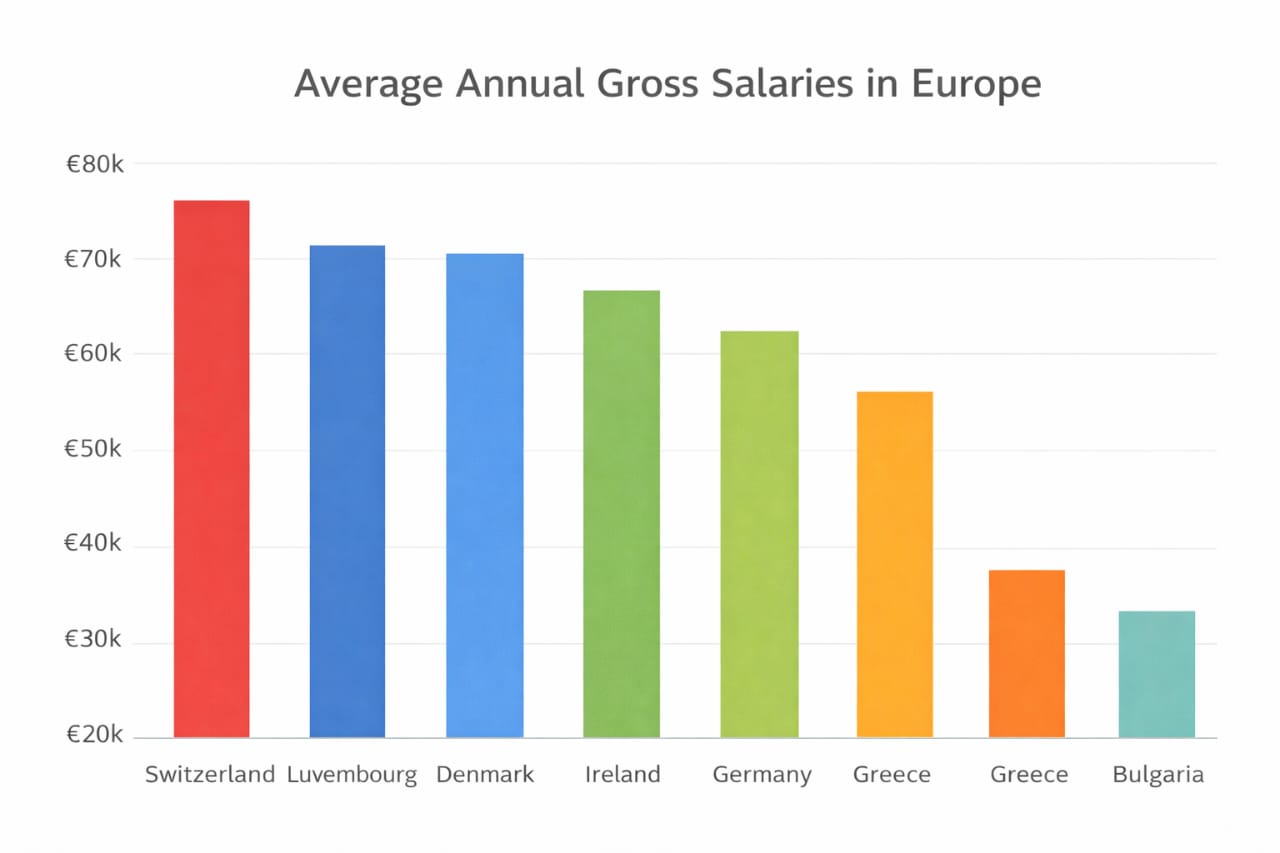
Some countries consistently report higher average annual salaries. Switzerland, Luxembourg, Denmark, Ireland, and Germany frequently sit near the top in terms of gross professional earnings. In certain Swiss cities, monthly net income can exceed €7,000. Luxembourg’s finance-driven labor market produces strong annual averages. Denmark and Ireland maintain competitive professional wages, and Germany continues to provide broad industrial stability.
Yet high income typically corresponds with higher baseline expenses. Housing, insurance systems, transport costs, and taxation structures must all be considered to understand financial reality.
How Do Salaries Differ Across European Regions?
Western and Northern Europe generally maintain higher average wages compared with Southern and Eastern Europe. These differences reflect economic scale, sector concentration, export performance, and labor productivity.
Western & Northern Europe
- Advanced industrial and service economies
- Strong labor protections
- Structured collective bargaining agreements
- Higher social contributions funding welfare systems
These economies support higher wages but also operate within higher cost environments.
Southern & Eastern Europe
- Lower average wage levels
- Lower property and rental markets in many cities
- Growing but uneven economic expansion
- Different tax burdens and contribution structures
In parts of Southern and Eastern Europe, average annual salaries remain significantly lower than in Western hubs. However, lower costs for housing, food, and services adjust real purchasing power differently than raw salary comparisons suggest.
Regional comparison must therefore shift from nominal income to spending capacity.
Why Cost of Living Is the Critical Variable
Cost of living determines how far income stretches within a particular city or region. Major metropolitan centers such as Zurich, Geneva, London, and Amsterdam consistently rank among Europe’s most expensive environments. Rental markets in Amsterdam frequently exceed €2,000 per month for central one-bedroom apartments. Swiss urban centers reflect high consumer price levels aligned with wage standards.
By contrast, secondary cities within the Netherlands, Germany, Portugal, or parts of Central Europe may offer lower housing pressure while preserving access to employment markets.
Professional financial planning in Europe typically evaluates:
- Net income after progressive taxation
- Housing cost as a percentage of salary
- Utility and energy expenses
- Mandatory insurance or health contributions
- Transport structure (public versus private)
- Long-term savings potential
Reliable comparison sources include Eurostat, OECD databases, and national statistics agencies. These institutions provide consistent macroeconomic context without commercial distortion.Cost of Living vs Salary in Europe: A City Comparison Guide

How Taxation and Social Contributions Shape Net Income
European economies typically apply progressive income tax systems combined with mandatory social contributions. These contributions finance:
- Public healthcare systems
- State pension schemes
- Unemployment protections
- Parental leave frameworks
- Disability and worker protections
Gross salary comparisons without understanding effective tax rates can be misleading. In many cases, higher tax deductions correspond with reduced private-sector financial risk, particularly in healthcare and retirement planning.
Taxation also varies significantly between countries. Some economies prioritize high public benefits financed through higher contribution rates. Others operate with lower income tax structures but may rely more heavily on private insurance systems.
Net disposable income is therefore more meaningful than gross contractual salary.
How European Labor Laws Influence Work-Life Balance
Work-life balance in Europe is supported by regulatory frameworks rather than informal company culture alone. Most countries operate within 36–40 standard working hours per week. France maintains a widely recognized 35-hour legal reference model. Nordic countries emphasize flexible scheduling and collective agreements. Luxembourg is known for generous leave entitlements in certain sectors.
EU-wide directives cap maximum working hours and protect minimum rest periods. Paid annual leave is mandatory across the EU, typically exceeding statutory minimums found in several non-European markets.
These regulations provide structural boundaries between professional and personal life. Cultural norms reinforce these boundaries in many countries, particularly in Germany and Scandinavia, where after-hours work communication is often limited.
Which European Countries Offer the Best Salary-to-Cost Ratio?
The best salary-to-cost ratio depends less on absolute wage levels and more on purchasing power.
Countries such as Switzerland provide high salaries but also operate within high cost environments. Luxembourg combines strong earnings with moderate geographic size, affecting housing supply. Germany often presents a balanced ratio due to stable wages combined with regional cost variation across cities.
Denmark and Sweden maintain high income structures alongside robust social protections, which offset private healthcare or childcare expenses. In contrast, Portugal and parts of Central Europe may offer lower salaries but reduced housing pressure, allowing certain professionals to maintain comfortable savings rates.
Evaluating salary-to-cost ratio requires examining:
- Disposable income after taxation
- Rental price trends
- Inflation exposure
- Public service accessibility
- Industry-specific wage demand
No single country dominates universally. Purchasing power shifts depending on profession, city selection, and housing strategy.
Is Europe Better Than the United States for Work-Life Balance?
The comparison between Europe and the United States often centers on structural differences rather than raw income figures.
The United States frequently offers higher peak salaries in technology, finance, and entrepreneurship sectors. However, paid leave policies are not federally standardized in the same way they are across EU member states. Healthcare financing structures also differ significantly.
European economies typically guarantee:
- Statutory paid annual leave
- Public healthcare access
- Parental leave protections
- Maximum working-hour limitations
By contrast, U.S. compensation packages often rely more heavily on employer-based benefits and private insurance systems. High-income professionals may experience greater earning potential in certain U.S. sectors, but work-life stability is frequently negotiated at the company level.
Whether Europe is “better” depends on individual priorities. Professionals prioritizing predictable leave, healthcare security, and regulated work hours often favor European systems. Those focused on high compensation growth or equity-based pay may prefer U.S. markets.
Both systems operate within distinct economic philosophies.
Minimum Wage and Entry-Level Context
Minimum wage levels vary across Europe and serve as baseline income protections. However, minimum wage figures are not representative of mid-level or specialist compensation.
Western Europe generally maintains higher statutory minimums than parts of Eastern Europe. Purchasing power adjustments remain essential when interpreting these figures. Entry-level professionals should use minimum wage as a floor reference rather than a career benchmark.
Evaluating Professional Life Realistically
Professional relocation within Europe requires integrated analysis rather than surface comparison. Effective evaluation includes:
- Gross contractual income
- Effective net income
- Local rental market conditions
- Public transport reliability
- Healthcare coverage structure
- Retirement system sustainability
- Job mobility within the region
- Industry growth trends
Economic conditions also evolve through inflation cycles, wage negotiations, and sector-specific demand shifts. Long-term sustainability depends on adaptability within regulated labor markets.
Final Perspective
European professional life operates within structured legal and economic frameworks. Salaries, cost of living, and work-life balance should be evaluated as an integrated system shaped by taxation models, welfare structures, labor protections, and local housing markets.
High salary does not automatically equal higher savings. Lower salary does not automatically equal lower quality of life. Financial stability in Europe is built through informed comparison, understanding of purchasing power, and alignment with personal career priorities.
When these elements are assessed together, professionals can form realistic expectations and sustainable long-term decisions.