
Europemigrationguide.com is reader-supported. When you buy through links on our site, we may earn an affiliate commission.
Best productivity systems for remote work are not built around tools—they are built around how you structure your time, protect your focus, and execute tasks consistently. Most people working remotely struggle not because they lack tools, but because they lack a system that controls how work flows throughout the day.
Quick Answer: The best productivity systems for remote work include time blocking for structured scheduling, deep work for focused execution, task batching for efficiency, and asynchronous communication to reduce distractions and improve workflow consistency.
If you want to improve focus, reduce distractions, and stay consistent while working remotely, these productivity systems will help you build a workflow that actually works.

Working remotely changes how your day unfolds. Without a clear structure in place, it’s easy for tasks, messages, and small distractions to take over your time without you noticing. Messages, notifications, and unplanned tasks begin to control your time instead of you controlling your work.
This is why productivity systems matter. They create a framework that guides how your day runs, how tasks are completed, and how focus is protected. Without that structure, even the best tools will not improve your productivity.
To understand how productivity systems connect with your overall workflow foundation, this guide explains the full structure clearly: remote work tools and productivity systems.
And if you are still trying to build the basic structure behind your workflow before optimising performance, this step-by-step guide breaks it down: how to set up remote work tools.
Why Most Remote Workers Struggle With Productivity
The biggest mistake people make is assuming productivity comes from motivation. In reality, productivity comes from structure. When there is no clear system guiding your day, you rely on decision-making for everything—what to do, when to do it, and how to prioritise tasks.
This constant decision-making creates mental fatigue. Over time, it reduces focus, slows down execution, and leads to inconsistent results.
In a traditional office, structure is built into the environment. In remote work, you have to create that structure yourself. That is exactly what productivity systems are designed to do.
They remove guesswork, reduce distractions, and create a repeatable workflow that allows you to focus on meaningful work instead of constantly managing your time.
The Core Productivity Systems That Actually Work
There are several productivity methods available, but only a few consistently work well in remote environments. These systems are effective because they address the main challenges of remote work: distractions, lack of structure, and inconsistent focus.
1. Time Blocking (Control Your Day Before It Starts)
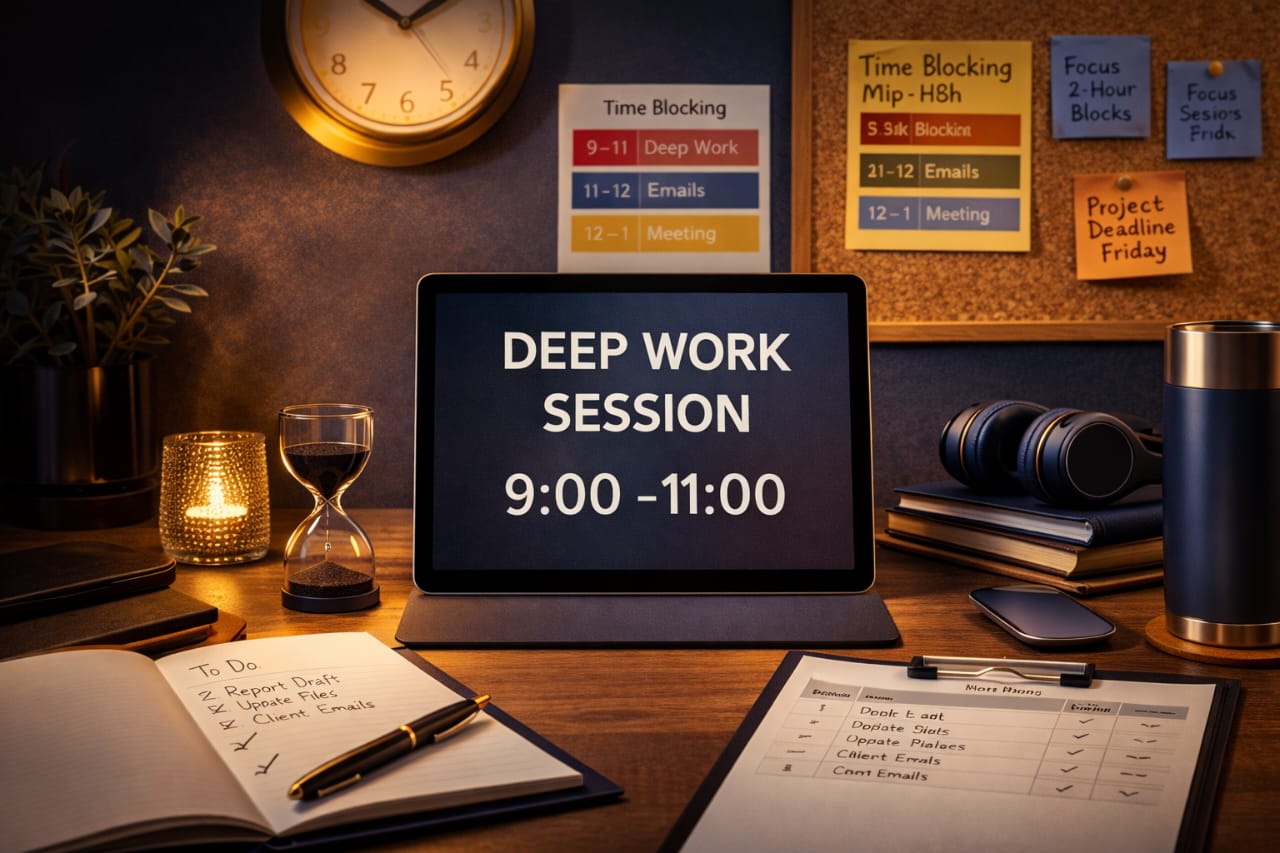
Time blocking is one of the most effective productivity systems because it forces you to plan your day intentionally. Instead of reacting to tasks, you assign specific time slots to specific types of work.
This creates clarity. You know exactly what you should be working on at any given time, which reduces distractions and improves focus.
A typical time-blocked day might include:
- Morning deep work session
- Midday communication and meetings
- Afternoon task execution
- End-of-day review and planning
This structure ensures that your most important work gets done when your focus is highest.
2. Deep Work (Where Real Productivity Happens)
Deep work is the ability to focus without distraction on a cognitively demanding task. This is where high-value work is produced.
In remote environments, deep work is often disrupted by constant notifications and multitasking. Without protecting this time, productivity drops significantly.
To apply deep work effectively:
- Work in uninterrupted blocks of 60–90 minutes
- Turn off notifications completely
- Focus on one task at a time
- Avoid switching between tasks
The difference between shallow work and deep work is significant. Shallow work keeps you busy. Deep work produces results.
3. Task Batching (Reduce Mental Switching)
Task batching involves grouping similar tasks together and completing them in one session. This reduces the mental cost of switching between different types of work.
For example, instead of checking emails throughout the day, you handle them at specific times. Instead of mixing communication with deep work, you separate them completely.
This improves efficiency because your brain stays focused on one type of task at a time.
4. Asynchronous Workflow (Work Without Constant Interruptions)
One of the biggest productivity killers in remote work is constant communication. Messages, calls, and meetings break your focus and reduce your ability to complete meaningful work.
An asynchronous workflow solves this problem by reducing the need for real-time communication. Instead of immediate responses, communication happens in a structured and delayed manner.
This allows you to protect your focus while still staying connected and informed.
How to Combine These Systems Into One Workflow
The real power of productivity systems comes from combining them into one structured workflow. Each system supports a different part of your work process.
For example:
- Time blocking structures your day
- Deep work drives high-value output
- Task batching improves efficiency
- Asynchronous communication protects focus
When combined, these systems create a workflow that is both structured and flexible.
Instead of constantly reacting to tasks, your day follows a clear pattern. This reduces stress, improves consistency, and allows you to produce better results over time.
Designing a Daily Productivity System That Works
A strong productivity system is not just about methods—it is about how your day is structured from start to finish.
A simple but effective daily structure looks like this:
- Morning (Deep Work): Focus on your most important tasks
- Midday (Communication): Handle messages and meetings
- Afternoon (Execution): Complete remaining tasks
- Evening (Review): Plan and organise the next day
This structure aligns your energy with your work. Instead of working randomly, you follow a system that supports productivity naturally.
Once this becomes a habit, your workflow becomes predictable—and that is where real efficiency comes from.
What High Performers Do Differently in Remote Work
The difference between average and highly productive remote workers is not effort—it is structure and discipline. Most people try to work harder, but high performers focus on working with intention.
They do not leave their day open to interruptions. Instead, they design their day in advance, protect their focus aggressively, and follow systems that reduce decision-making.
This is where productivity systems become more than just techniques—they become operating rules.
For example, a high performer does not start the day by checking messages. They start with deep work. They do not mix tasks randomly. They group similar work together. They do not respond instantly to everything. They control when communication happens.
These small differences create a massive gap in output over time.
Once you begin to apply this level of structure, you will notice something important—work feels easier, not harder. That is because your system is doing the heavy lifting for you.
How to Protect Your Focus in a Remote Environment
Focus is your most valuable resource in remote work, yet it is also the easiest to lose. Notifications, background noise, and constant task-switching quietly reduce your productivity without you noticing.
Protecting your focus is not about willpower—it is about environment and rules.
This means creating conditions where distractions are reduced before they happen. For example, turning off notifications during deep work sessions is not optional—it is necessary.
It also means controlling when you are available. If you are always reachable, your work will always be interrupted.
A simple rule that works well is this: if it is not urgent, it can wait. This mindset alone can significantly improve your ability to complete meaningful work.
Another important factor is your internet reliability. Even small disruptions in connectivity can break your focus and interrupt your workflow, especially during deep work or important tasks.
That is why many remote professionals rely on reliable mobile internet for remote work to maintain consistent access to their tools and workflow, regardless of their location.
It may seem like a small detail, but stable connectivity plays a major role in maintaining uninterrupted productivity.
Why Simplicity Always Wins in Productivity Systems
One of the biggest mistakes people make is overcomplicating their productivity system. They combine too many methods, follow too many rules, and try to optimise everything at once.
This usually leads to burnout or inconsistency.
The most effective systems are simple, repeatable, and easy to follow daily. You do not need ten different techniques—you need a few that work consistently.
For example, combining time blocking with deep work and task batching is already enough to create a powerful workflow. Adding more layers does not always improve results.
Simplicity reduces friction. And in remote work, less friction means better execution.
Once your system becomes easy to follow, you stop relying on motivation and start relying on structure. That is when productivity becomes consistent.
The Long-Term Advantage of Using Productivity Systems
Productivity systems are not just about getting more done today—they are about building a sustainable way of working over time.
Without a system, your productivity will always fluctuate. Some days will feel productive, others will feel scattered. Over time, this inconsistency slows down progress.
With a system, your output becomes more stable. You know how your day will run, how tasks will be completed, and how your workflow will evolve.
This stability is what allows remote professionals to grow, take on more work, and maintain high performance without burning out.
It also creates confidence. When you trust your system, you stop second-guessing your process and focus entirely on execution.
And that is the real goal—not just to work more, but to work better with less stress and more control.
How to Turn Your Productivity System Into a Scalable Remote Workflow
Building the best productivity systems for remote work is only the starting point. The real advantage appears when that system becomes scalable—when it can handle more work, tighter deadlines, and increased complexity without breaking down.
At the beginning, simple structures like time blocking and deep work are enough to create control. But as your workload grows, small inefficiencies begin to surface. Tasks start overlapping, communication becomes harder to manage, and your workflow begins to feel heavier than it should.
This is where optimisation becomes essential. A scalable productivity system is not about doing more—it is about removing friction so your work flows naturally without constant effort.
If you are still refining your tool choices alongside your productivity system, this guide helps you understand the best starting point: best remote work tools for beginners.
And if you want to understand when it makes sense to upgrade your workflow with better features or systems, this breakdown explains the decision clearly: free vs paid remote work tools.
From Structured Days to High-Performance Systems
The transition from a basic productivity setup to a high-performance system is subtle but powerful. It is not about changing everything—it is about refining what already works.
At this level, your focus shifts from managing tasks to managing energy, attention, and consistency. You are no longer just completing work—you are optimising how that work gets done.
This is where most people begin to notice a major difference. Instead of feeling busy all day, they start producing meaningful results in less time.
The system becomes smoother. Decisions become easier. Execution becomes faster.
Eliminating Friction in Your Workflow
Friction is anything that slows down your work unnecessarily. It could be switching between tasks too often, unclear priorities, or constant interruptions.
Reducing friction is one of the fastest ways to improve productivity.
This can be done by simplifying your workflow, reducing unnecessary steps, and ensuring that every part of your system has a clear purpose.
For example, if you find yourself constantly checking messages during deep work, that is friction. If your tasks are unclear, that is friction. If your day lacks structure, that is friction.
Once you identify these issues, your goal is simple—remove them.
Optimising Energy, Not Just Time
Time management is important, but energy management is what truly drives productivity. Not all hours of the day are equal. Some periods are better for deep focus, while others are better for lighter tasks.
High-performing remote workers align their tasks with their energy levels. They do deep work when their focus is highest and handle communication or administrative tasks when their energy drops.
This alignment improves both efficiency and output without increasing effort.
Instead of forcing productivity, you work with your natural rhythm.
Creating a Sustainable Remote Work Routine
A productivity system without a routine will always break down. Consistency is what turns a system into a habit, and habits are what sustain long-term performance.
Your routine should support your system, not compete with it.
This means creating a predictable structure that you can follow daily without overthinking it.
Start With Clear Priorities
Every productive day begins with clarity. Knowing what needs to be done removes hesitation and helps you start quickly.
Without clear priorities, you waste time deciding what to do instead of actually working.
Protect Your Deep Work Time
This is non-negotiable. Deep work is where your most valuable output comes from, and it should be treated as your highest priority.
Everything else—messages, meetings, and minor tasks—should be scheduled around it.
Control Communication Windows
Instead of being available all day, define specific times for communication. This reduces interruptions and allows you to maintain focus for longer periods.
It also improves the quality of your responses because you are not constantly switching between tasks.
End With a System Reset
At the end of your day, review what you completed, update your tasks, and prepare for the next day. This keeps your system clean and ready to go.
It also reduces mental clutter, allowing you to disconnect from work more effectively.
The Role of Environment in High-Level Productivity
Your environment has a direct impact on how well your productivity system performs. Even the best system will struggle in a space filled with distractions, noise, or instability.
A well-structured environment supports focus, reduces interruptions, and makes it easier to follow your workflow consistently.
This includes both your physical setup and your digital environment.
For remote professionals who work across different locations, maintaining consistency becomes more challenging. Having the right support systems in place helps reduce that uncertainty.
Using reliable protection for remote travel and work ensures that unexpected disruptions do not affect your ability to stay productive.
At the same time, maintaining balance is important. Productivity is not just about working—it is also about recovering. Exploring your surroundings and taking breaks helps improve long-term focus and prevents burnout.
Platforms like experience and activity booking for remote workers make it easier to maintain that balance while working remotely.
Common Mistakes That Limit Productivity Growth
Even with a strong system, certain mistakes can slow down your progress if they are not addressed early.
One of the most common issues is overcomplicating your workflow. Adding too many systems or techniques creates confusion instead of improving performance.
Another mistake is inconsistency. A system only works if it is followed regularly. Skipping steps or changing your workflow constantly reduces its effectiveness.
Ignoring small inefficiencies is also a problem. What seems minor at first can grow into a major obstacle over time.
The solution is simple—keep your system clear, follow it consistently, and improve it gradually.
Frequently Asked Questions
What is the best productivity system for remote work?
The best system combines time blocking, deep work, task batching, and controlled communication to create a structured and efficient workflow.
How do I stay focused while working remotely?
Protect your deep work time, reduce distractions, and follow a structured daily routine that supports your productivity system.
Do productivity systems really work?
Yes. They reduce decision fatigue, improve consistency, and help you manage your time and tasks more effectively.
How long does it take to build a productivity system?
You can set up a basic system quickly, but refining it into a consistent habit takes time and regular use.
Can beginners use advanced productivity systems?
Yes. Starting simple and improving gradually is the most effective approach.
Conclusion
Best productivity systems for remote work are not about complexity—they are about clarity, structure, and consistency. When your workflow is organised and your focus is protected, productivity becomes predictable instead of random.
The real advantage comes from building a system that works for you and improving it over time. Once your system becomes stable, your work becomes easier to manage and your results improve naturally.
At that point, you are no longer relying on motivation—you are relying on a system that supports you every single day.