
Europemigrationguide.com is reader-supported. When you buy through links on our site, we may earn an affiliate commission.
How to stay consistent while job hunting is one of the biggest challenges beginners face when trying to get a remote job. It is not a lack of opportunities that stops most people—it is inconsistency, confusion, and burnout. When your job search has no structure, it quickly becomes frustrating, and over time, that frustration builds into doubt. Eventually, many people stop not because they cannot succeed, but because the process feels too unpredictable to continue.
Quick Answer: To stay consistent while job hunting, build a structured daily routine, focus on 3–5 high-quality applications instead of mass applying, track every application, and divide your workflow into clear phases like applying, tracking, and discovery.
At the beginning, many people believe consistency comes from motivation. That idea sounds good, but it does not hold up in real situations. Motivation is unstable—it changes based on mood, results, and energy. What actually creates consistency is structure. When you know exactly what to do each day, you remove the need to rely on feelings. You simply follow a system, and over time, that system produces results.
This is where most beginners struggle without realising it. They wake up, open multiple job boards, scroll endlessly, click random listings, apply without focus, and then close their laptop feeling mentally drained. On the surface, it looks like effort was made, but underneath, there is no direction. Without a clear workflow, effort turns into scattered activity, and scattered activity rarely leads to results.
What makes this worse is the lack of visible progress. When you cannot measure what you are doing, it feels like nothing is working. That feeling is what slowly kills consistency. Not failure—uncertainty.
Why Most People Fail to Stay Consistent in Job Hunting
Consistency breaks down when your job search feels unpredictable. Human behaviour is naturally tied to feedback—when you see progress, you continue; when you do not, you slow down. In remote job hunting, results are delayed. You may apply today and not hear back for weeks. Without understanding this delay, many beginners interpret silence as failure.
This leads to one of the biggest problems: unrealistic expectations. Many people assume that sending applications should immediately lead to responses. When that does not happen, they begin to question their skills, their CV, or even the entire idea of remote work. In reality, the process is working exactly as it should—slow, competitive, and selective.
Another major issue is lack of clarity in direction. When you are unsure about the type of role you are targeting, your job search becomes scattered. One day you apply for data entry roles, the next day customer support, and the next day marketing. This constant switching prevents you from building a focused profile, and over time, it weakens your positioning.
This lack of direction also creates decision fatigue. Every application requires new thinking, new adjustments, and new positioning. That mental effort adds up quickly, making it harder to stay consistent over time.
If you are still unsure which roles are realistic for you as a beginner, this guide explains the best options clearly: best remote jobs for beginners no experience.
Once you remove confusion and commit to a clear direction, your job search becomes easier to manage. You are no longer reacting to every opportunity—you are selecting the right ones.
The Daily Routine That Builds Real Consistency
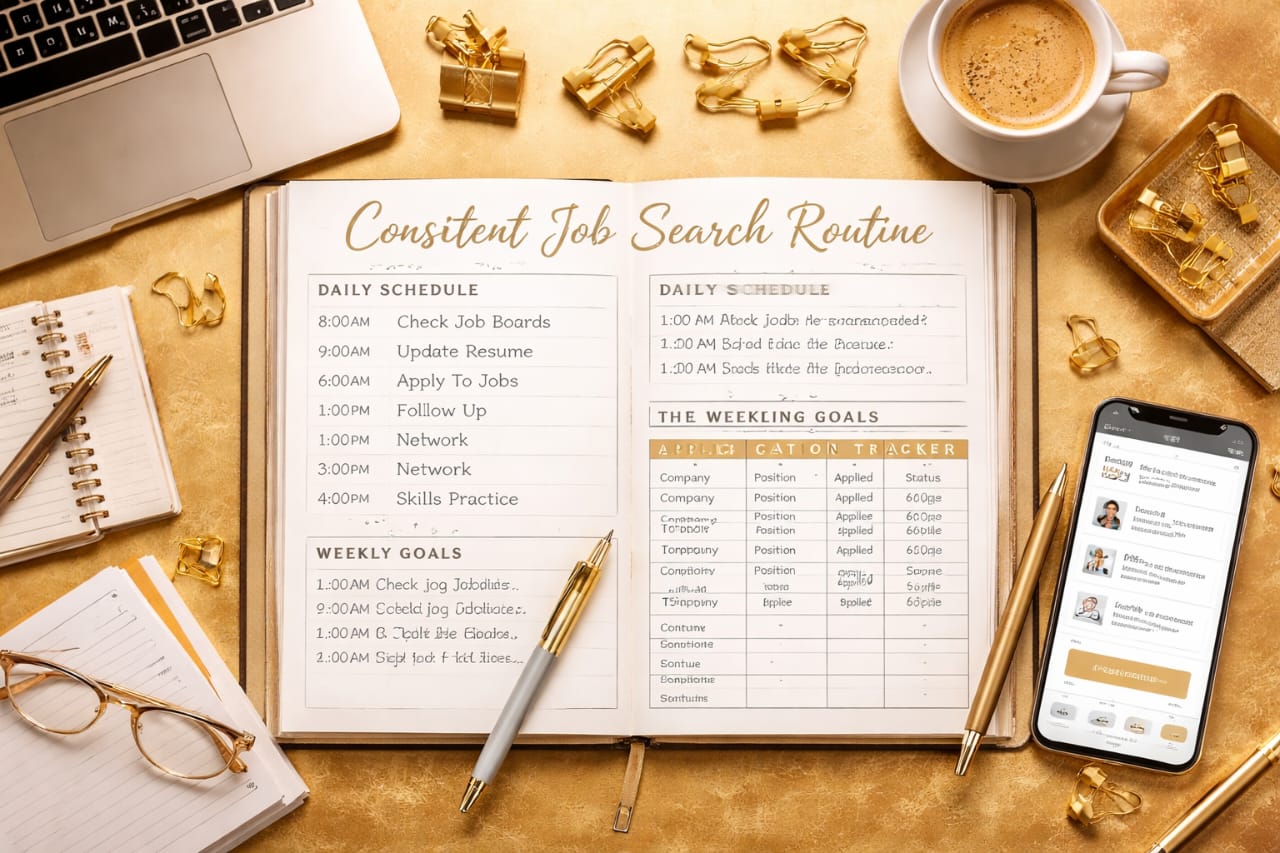
Consistency is not built through intensity—it is built through repeatable structure. A strong daily routine removes unnecessary decisions and creates a rhythm that your mind can follow. Instead of asking “what should I do today?”, you already know.
The most effective job search routine is divided into three core phases: application, tracking, and discovery. Each phase serves a different purpose, and skipping any of them weakens your overall system.
Morning (Deep Work – Applications): This is where your most important work happens. Your energy is highest, your focus is strongest, and your ability to think clearly is at its peak. Instead of applying to as many jobs as possible, you focus on 3–5 high-quality applications.
This means carefully reading the job description, adjusting your CV to match key requirements, and writing responses that reflect understanding, not repetition. This level of effort increases your chances significantly because employers are not looking for volume—they are looking for relevance.
Mid-Day (Tracking & Follow-Ups): After applying, your job is not finished. This is where most beginners lose control of their process. Without tracking, applications disappear into memory, and opportunities are forgotten.
Tracking creates visibility. It allows you to see what you have done, what is pending, and where you need to follow up. It also helps you avoid applying to the same roles repeatedly, which is a common mistake among beginners.
Afternoon (Job Discovery): This phase is focused on finding new opportunities, but it must be done with intention. Instead of scrolling endlessly, you search using targeted keywords and filters that match your skill level.
This approach reduces overwhelm and ensures that the opportunities you find are relevant. Over time, this makes your job search more efficient and less mentally exhausting.
If you want to understand how to approach applications correctly and improve your chances of getting responses, this guide explains it step-by-step: best websites to find remote jobs for beginners.
Why Quality Applications Beat Quantity Every Time
It is easy to assume that applying to more jobs increases your chances, but in reality, it often does the opposite. When you apply to too many roles, the quality of each application drops. Your CV becomes generic, your responses become repetitive, and your overall presentation weakens.
Employers reviewing applications can quickly recognise generic submissions. These are often ignored because they show no clear alignment with the role. This is why many beginners send dozens of applications without receiving responses—it is not about effort, it is about positioning.
Focusing on fewer applications allows you to be precise. You can match your skills to the job requirements, highlight relevant experience (even if it is basic), and communicate clearly. This creates a stronger impression and increases your chances of moving forward.
There is also a psychological advantage. When your workload is controlled, your stress level decreases. You are no longer overwhelmed by the number of applications you need to send. Instead, you are focused on doing a few things well.
This shift—from quantity to quality—is what makes consistency sustainable. You are not chasing volume; you are building results.
The Role of Environment and Setup in Staying Consistent
Your environment plays a bigger role in consistency than most people realise. Even with the best intentions, a poor setup can disrupt your workflow. Distractions, unstable internet, and cluttered spaces all reduce your ability to focus.
Creating a simple and organised workspace removes unnecessary friction. When your environment is ready, you can start working immediately without preparation. This small change has a significant impact over time.
Reliable internet is also critical. Remote job applications, communication, and interviews all depend on stable connectivity. Any interruption can break your workflow and affect your confidence.
Many remote job seekers rely on reliable global internet access for remote job applications to maintain consistency and avoid disruptions during important stages of the process.
When your environment supports your workflow, consistency becomes easier because there are fewer barriers between you and your work.
How to Build a Simple Job Tracking System That Works
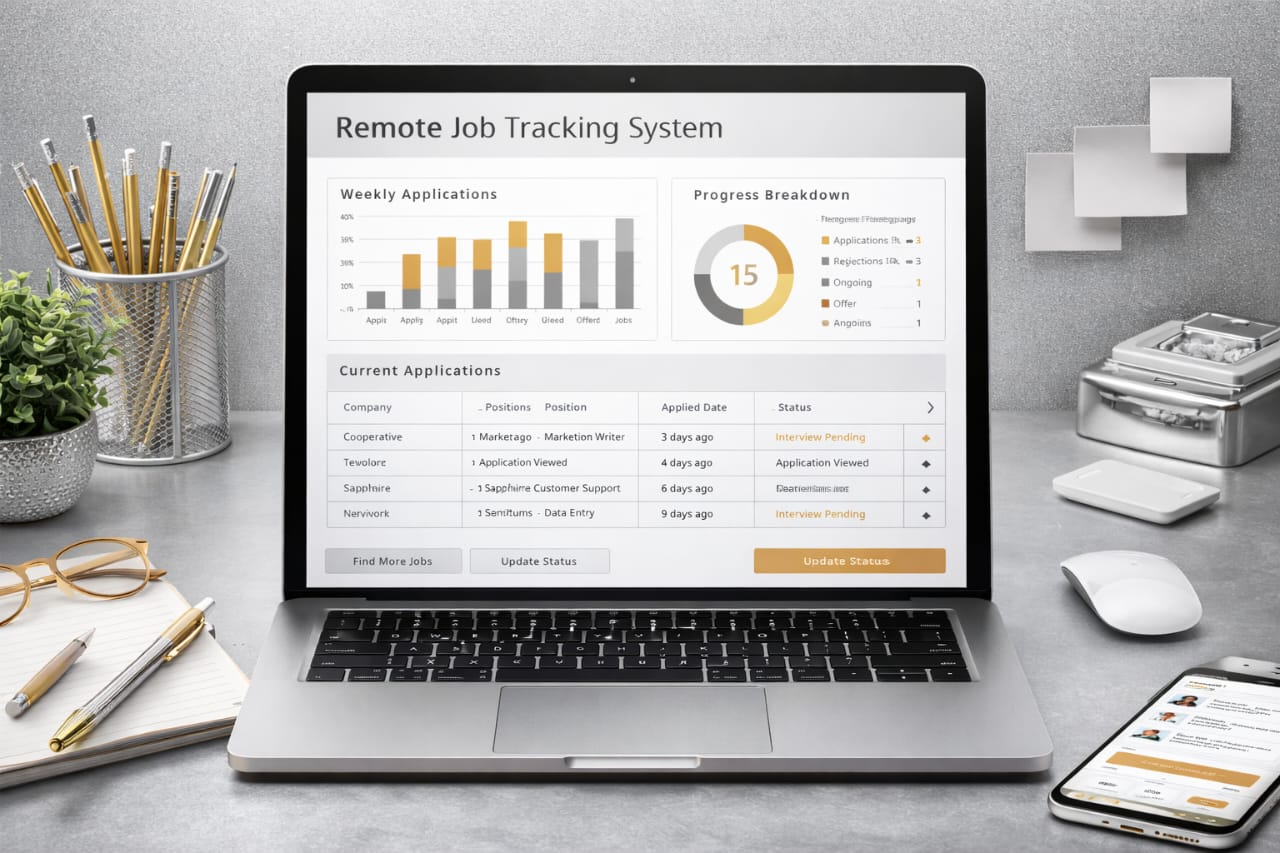
A job tracking system transforms your job search from guesswork into a structured process. Without tracking, everything feels scattered. With tracking, every action has a place and a purpose.
You do not need advanced tools to start. A simple system that includes the company name, role, date applied, and current status is enough. The goal is not complexity—it is clarity.
Over time, this system allows you to identify patterns. You begin to see which types of roles respond more, which platforms perform better, and where your approach needs improvement. This level of insight is what separates random effort from strategic action.
Tracking also supports follow-ups. Instead of forgetting applications, you can revisit them at the right time and increase your chances of getting noticed. Many opportunities are missed simply because there was no follow-up.
When you combine a structured routine with a tracking system, your job search becomes predictable. And once something becomes predictable, it becomes easier to stay consistent with it.
How to Build Long-Term Consistency Without Burning Out
Staying consistent while job hunting is not just about having a routine—it is about maintaining that routine over weeks and months without losing energy. Most people struggle at this stage. They start strong, follow a system for a few days, and then gradually stop when results do not come immediately.
The key to long-term consistency is sustainability. If your routine feels too heavy, too demanding, or too time-consuming, you will eventually abandon it. This is why your system must be realistic. It should fit your energy level, your schedule, and your current situation.
One effective way to achieve this is by reducing unnecessary pressure. You do not need to apply for 20 jobs a day. You do not need to be online all the time. What matters is steady, focused progress. A system that you can repeat every day is more powerful than one that you can only maintain for a short period.
Another important factor is mental separation. Your job search should not consume your entire day. When everything revolves around applications, rejection feels more personal and more intense. By limiting your job search to specific time blocks, you create balance. This helps you stay consistent without feeling overwhelmed.
The Hidden Power of Tracking and Feedback Loops
Tracking your applications is not just about organisation—it is about creating feedback. Without feedback, you cannot improve. Many people realise too late that they have been repeating the same actions without knowing what works.
When you track your applications properly, patterns begin to appear. You may notice that certain types of roles respond more often. You may realise that specific keywords improve your visibility. You may also identify mistakes that reduce your chances.
This feedback loop is what allows you to refine your approach. Instead of guessing, you are making adjustments based on real data. Over time, this leads to better results with less effort.
If you want to improve your application success rate and understand what actually works, this guide explains the full process: how to apply for remote jobs without experience.
Once you start learning from your own data, your job search becomes more strategic. You are no longer repeating the same mistakes—you are evolving.
How to Stay Mentally Strong During Job Rejections
Rejection is one of the biggest threats to consistency. Even when you are doing everything right, you will still face rejection. Most people only understand this after going through it repeatedly. This is not a sign that your system is failing—it is part of the process.
The mistake many beginners make is taking rejection personally. They see it as a reflection of their abilities, when in reality, hiring decisions are influenced by many factors beyond your control. Timing, competition, internal hiring priorities, and even small details can affect outcomes.
To stay consistent, you need to change how you interpret rejection. Instead of seeing it as failure, treat it as neutral feedback. It simply means that this particular opportunity was not the right match at that moment.
Another effective strategy is detachment. Focus on the process, not the outcome. Your goal is not to get a response from every application—it is to follow your system consistently. When you shift your focus this way, rejection loses its emotional impact.
This mindset is what allows experienced job seekers to continue applying even after multiple rejections. They understand that results come from repetition, not perfection.
Tools That Make Consistency Easier
While your system is the foundation, the right tools can make consistency easier to maintain. These tools are not mandatory, but they reduce friction and help you stay organised.
Job tracking tools, for example, allow you to manage applications efficiently. Instead of relying on memory, you can see everything in one place. This reduces confusion and saves time.
Scheduling tools can also help you maintain your routine. By setting specific time blocks for applications, tracking, and discovery, you create structure in your day.
Stable connectivity is another important factor. Remote job searching requires constant access to platforms, emails, and communication tools. Many job seekers rely on reliable mobile data solutions for remote work to stay connected and avoid interruptions.
Additionally, if your job search involves exploring different locations or preparing for relocation opportunities, having access to flexible transport options for navigating new environments can make the transition smoother when opportunities arise.
Tools do not replace effort, but they remove obstacles. And when obstacles are removed, consistency becomes easier to maintain.
Common Mistakes That Break Consistency
Even with a good system, certain mistakes can disrupt your progress. One of the most common is overcomplicating the process. When your routine becomes too detailed or too rigid, it becomes difficult to maintain.
Another mistake is constantly changing your strategy. Switching approaches too often prevents you from seeing results. Consistency requires time. If you change your method every few days, you never give any approach enough time to work.
There is also the problem of comparison. Seeing others succeed quickly can create pressure and self-doubt. This often leads to frustration and inconsistency. It is important to remember that every job search journey is different.
If you want to protect yourself from common traps that waste time and break consistency, this guide explains what to avoid: remote job scams to avoid.
Avoiding these mistakes is just as important as following the right strategy. Sometimes, progress comes from removing what is slowing you down.
Frequently Asked Questions (FAQ)
How many jobs should I apply to per day?
The ideal number is 3–5 high-quality applications per day. This allows you to focus on tailoring each application instead of sending generic submissions. Quality increases your chances of getting responses.
How long should I spend job hunting daily?
Most beginners benefit from 3–5 hours per day, divided into structured phases. This includes time for applications, tracking, and job discovery. The key is not the number of hours, but how focused those hours are.
What is the best way to stay motivated?
Instead of relying on motivation, focus on building a system. Motivation changes daily, but a structured routine remains stable. When you follow a clear process, consistency becomes automatic.
Why am I not getting responses?
This is often due to lack of alignment between your application and the job requirements. Improving your CV, targeting the right roles, and applying strategically can increase your chances.
Is it normal to feel stuck during job hunting?
Yes, it is completely normal. Job searching involves uncertainty and delayed results. The key is to stay consistent with your system, even when progress is not immediately visible.
Conclusion: Consistency Is a System, Not a Feeling
Staying consistent while job hunting is not about working harder—it is about working with structure. When you build a clear routine, track your progress, and focus on quality over quantity, your job search becomes manageable.
Consistency is not something you wait for. It is something you build through systems, habits, and repetition. Once that system is in place, your progress becomes predictable, and your chances of success increase significantly.
The difference between those who succeed and those who stop is not talent—it is the ability to continue, even when results are not immediate.