
Europemigrationguide.com is reader-supported. When you buy through links on our site, we may earn an affiliate commission.
How to pass a remote job interview is no longer about simply answering questions correctly or showing basic knowledge of a role. It is about proving, in a very clear and practical way, that you can operate independently, communicate without confusion, and deliver results in a fully digital environment where supervision is minimal. Remote hiring has evolved significantly, and employers are now evaluating behaviour, thinking patterns, and execution ability rather than just qualifications or certificates.
Quick Answer: To pass a remote job interview, you must demonstrate structured communication, show proof of independent work ability, prepare a distraction-free professional setup, understand how remote hiring works, and answer questions using clear, result-based examples that show how you think and execute tasks.
If you want to understand how to pass a remote job interview and stand out as a beginner, this guide breaks down exactly what employers look for and how to prepare step by step.
What makes remote interviews different is the level of responsibility placed on you from the very beginning. Employers are not just hiring someone to complete tasks—they are hiring someone who can manage themselves, stay consistent without reminders, and communicate progress without being chased. This means your preparation must go beyond memorising answers and focus more on how you present your thinking, your workflow, and your ability to operate without supervision.
Many candidates struggle at this stage not because they are unqualified, but because they approach remote interviews with the wrong mindset. They give generic answers, speak in vague terms, and fail to demonstrate how they actually work in real situations. Employers notice this immediately. Once you understand that remote interviews are about clarity, proof, and structure, your entire approach changes—and that is when your chances start improving significantly.
I’ve seen people miss opportunities simply because their answers sounded unclear, even when they actually knew what they were doing.
What Employers Actually Look for in Remote Interviews
In today’s remote hiring environment, employers are not just listening to what you say—they are analysing how you think, how you structure your responses, and how clearly you communicate your ideas. Because they cannot physically observe you working, they rely heavily on signals during the interview to determine whether you can function effectively in a remote setup without constant supervision or guidance.
One of the strongest signals employers look for is ownership. This means your ability to take responsibility for tasks, identify problems early, and solve them without waiting for detailed instructions. When you speak in a way that shows initiative—explaining what you did, why you did it, and what result you achieved—you immediately stand out as someone who can be trusted in a remote role.
Another major factor is digital fluency, which goes beyond just knowing tools. It includes how you communicate in writing, how you organise information, and how you collaborate without physical interaction. Employers expect you to be comfortable working across platforms, managing tasks, and keeping communication clear and structured even when conversations are asynchronous.
Clarity of communication is also critical. Remote work removes the advantage of physical cues like body language, so your words must carry the full weight of your message. Employers are looking for candidates who can explain ideas simply, avoid unnecessary complexity, and communicate in a way that is easy to understand and act on.
If you are still figuring out where you fit as a beginner, understanding the types of roles that align with your current level can help you position yourself more effectively: best remote jobs for beginners no experience. This clarity directly improves how you present yourself in interviews.
How Remote Interviews Are Different From Traditional Interviews
The difference between remote and traditional interviews is deeper than just the format—it is a completely different evaluation system. In a physical interview, your presence, environment, and energy naturally contribute to how you are perceived. In a remote interview, everything is filtered through a screen, which means your communication, structure, and clarity become far more important than personality alone.
Remote interviews are also more structured and, in many cases, more analytical. Employers often use predefined evaluation criteria, recorded responses, or AI-assisted screening systems to assess candidates. This means your answers need to be aligned, relevant, and easy to evaluate quickly. Long, unstructured responses reduce your chances because they create friction for the interviewer.
Another key difference is the emphasis on asynchronous work. Many companies operate across different time zones, so they want to know if you can work without constant real-time communication. This is why questions about how you manage tasks, document your work, and communicate updates are more common in remote interviews.
Understanding these differences allows you to adjust your approach strategically. Instead of trying to impress with personality alone, you focus on delivering clear, structured, and relevant answers. This shift is what makes your performance stronger and more aligned with what employers are actually looking for.
Setting Up a Professional Remote Interview Environment
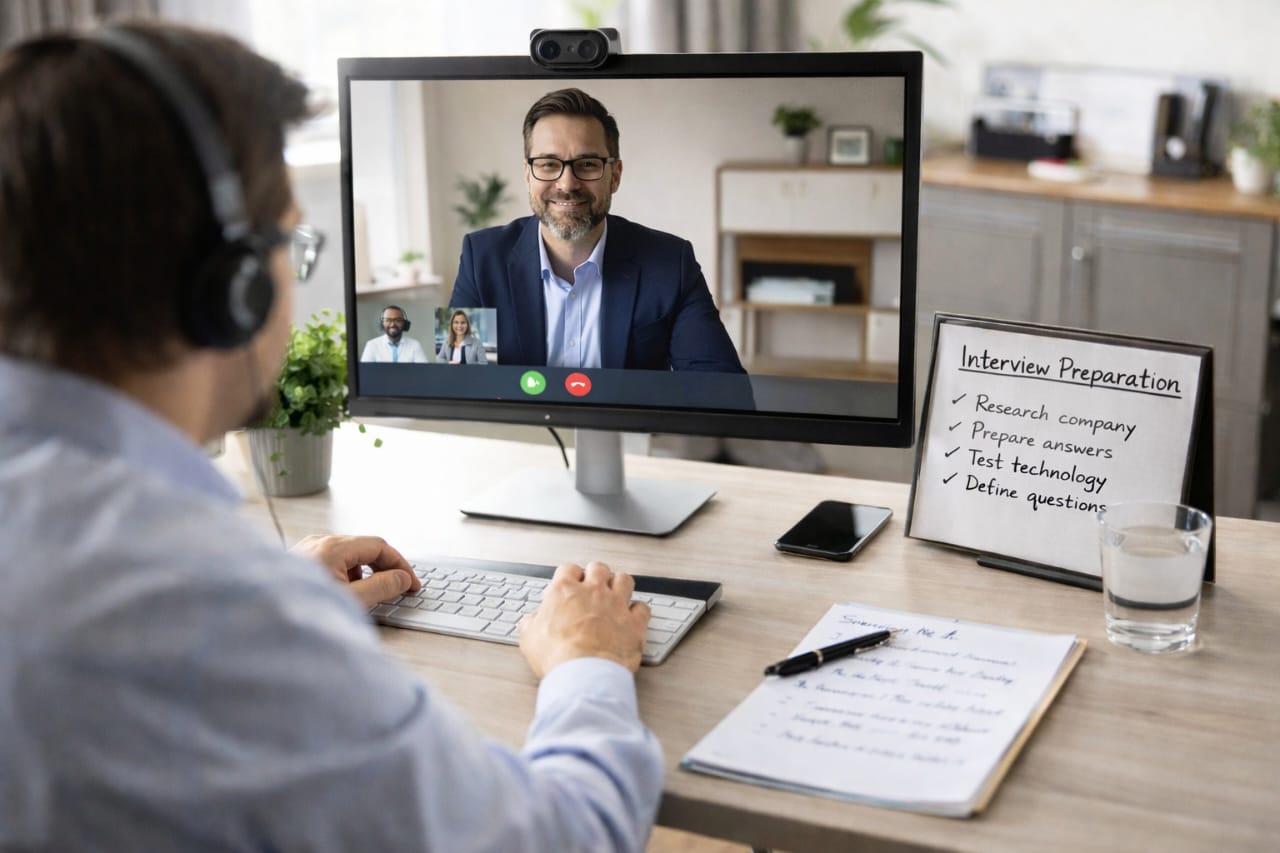
Your interview setup is not just a background detail—it is part of your evaluation. In remote hiring, employers use your environment as a signal to judge your level of organisation, professionalism, and attention to detail. A poorly prepared setup can distract from your answers, while a clean and structured environment strengthens your overall impression.
Lighting plays a major role in how you are perceived. When your face is clearly visible, it improves engagement and makes communication feel more natural. Natural light is ideal, but even a simple front-facing light can create a professional appearance that improves how you come across on screen.
Audio quality is equally important. Clear sound ensures that your message is delivered without interruptions or confusion. Background noise, echo, or low-quality microphones can create friction during the conversation and reduce the impact of even strong answers.
Your background should be simple, neutral, and free from distractions. A cluttered space can subconsciously signal disorganisation, while a clean setup reflects focus and intentionality. These small details influence how seriously you are perceived as a candidate.
Connection stability is another critical factor. A disrupted interview breaks flow and affects communication. Using a reliable global data connection for remote interviews helps ensure that your session runs smoothly, allowing you to focus fully on your performance instead of technical issues.
How to Answer Remote Interview Questions Effectively
Answering questions effectively in a remote interview is less about saying more and more about saying things clearly. Employers are not impressed by long explanations—they are impressed by structured thinking and the ability to communicate ideas in a simple, logical way that is easy to follow.
The most effective way to answer questions is by using a structured approach such as context, action, and result. This allows you to explain what happened, what you did, and what outcome you achieved. This format works because it mirrors how real work is evaluated—by actions and results, not just intentions.
For example, instead of saying you are good at communication, explain a specific situation where you clarified a misunderstanding, improved a process, or helped a team move forward. Specific examples make your answers more believable and easier for employers to trust.
Another important factor is pacing. Speaking too fast, over-explaining, or jumping between ideas can make your answers difficult to follow. Taking a brief pause before responding helps you organise your thoughts and deliver a clearer answer.
If you are starting from a beginner level, learning how to position your experience properly will significantly improve your interview performance: how to get your first remote job without experience. Positioning is what turns simple experience into strong answers.
Clarity, structure, and relevance are what separate strong candidates from average ones. When your answers are easy to understand and directly connected to the role, you naturally stand out without needing to overcomplicate anything.

Advanced Remote Interview Strategies That Actually Make You Stand Out
At a surface level, most candidates prepare for remote interviews by reviewing common questions and practicing answers, but that approach alone is not enough to stand out. At a higher level, success comes from strategy—how you position your answers, how clearly you communicate your thinking, and how easily an employer can trust you to operate without supervision. Remote interviews are not just about correctness; they are about confidence in your ability to deliver results consistently.
One of the most effective ways to stand out is by shifting your focus from tasks to outcomes. Instead of explaining what you were asked to do, explain what you achieved and how your actions contributed to a measurable result. This immediately changes how you are perceived because employers are not looking for activity—they are looking for impact. When your answers consistently highlight results, you position yourself as someone who adds value rather than just follows instructions.
Another important strategy is alignment. Strong candidates naturally align their responses with the expectations of the role without being prompted. If a position requires independence, your answers should clearly demonstrate how you organise your work, solve problems, and manage responsibilities without constant guidance. This removes doubt and allows the interviewer to picture you already functioning in the role.
Consistency across your responses also plays a major role in how you are evaluated. Each answer should reinforce a clear identity—structured, reliable, and capable of working remotely. When your communication follows a consistent pattern, your overall impression becomes stronger, making it easier for employers to trust your ability.
How to Answer Remote Interview Questions With Structure and Clarity
Remote interview questions are designed to test how you think in real situations rather than how much you have memorised. This means your answers must be practical, structured, and easy to follow. Employers are trying to understand your decision-making process, your ability to handle challenges, and how you communicate your thoughts under pressure.
For communication-based questions, your focus should be on clarity and organisation. Instead of saying you communicate well, explain how you structure your messages, how you ensure there is no confusion, and how you maintain clarity even when working asynchronously. This shows that you understand communication as a system rather than just a skill.
When answering questions about time management, avoid vague statements. Describe your process clearly—how you plan tasks, how you prioritise work, and how you adjust when unexpected changes occur. Specific systems demonstrate reliability and control, while general answers reduce confidence in your ability.
Problem-solving questions are especially important in remote roles. Employers want to know how you react when challenges arise and there is no immediate support available. Explaining how you identify problems, analyse options, and take action independently shows that you can handle real responsibilities without supervision.
The goal is to make every answer easy to understand and directly relevant. When your responses are structured and supported with clear examples, they become more convincing and easier for employers to evaluate.
Understanding the Remote Interview Evaluation Process
Remote interviews are often evaluated using structured systems rather than informal judgement. Employers assess candidates based on specific criteria such as clarity, relevance, communication ability, and problem-solving skills. This means your performance must be consistent from beginning to end, not just strong in isolated moments.
Consistency is what builds trust. If your answers are clear at the start but become vague later, it creates uncertainty about your ability to perform reliably. Employers are looking for stability in how you communicate and think, because that reflects how you will operate in a real remote environment.
Ease of communication is another major factor. Employers naturally prefer candidates who are easy to understand and easy to work with. When your answers are structured and your explanations are clear, the conversation flows better, creating a more positive experience for the interviewer.
Alignment with remote workflows also plays an important role. Companies want to see that you understand how remote teams operate, including asynchronous communication, independent task management, and structured workflows. When your answers reflect this understanding, it shows that you can integrate into their system without difficulty.
Once you understand how you are being evaluated, your approach becomes more focused. Instead of guessing what to say, you deliver answers that match exactly what employers are looking for.
Mistakes That Quietly Reduce Your Chances
Many candidates reduce their chances without realising it because of small but impactful mistakes. One of the most common is over-explaining. Long, unstructured answers make it harder for the interviewer to follow your point and weaken the clarity of your message.
Lack of specificity is another major issue. Saying general things without examples does not provide enough evidence for employers to trust your ability. Clear and simple examples are far more effective because they demonstrate real understanding and practical ability.
Poor listening also affects performance. When candidates answer questions without fully understanding them, their responses become slightly off-target. This signals a lack of attention to detail, which is a critical skill in remote work environments.
Technical issues can also reduce your chances. Poor audio, unstable connections, or distracting environments interrupt the flow of the interview and make communication more difficult. Preparing your setup in advance ensures that your performance is not affected by avoidable problems.
Removing these mistakes immediately improves your clarity, which is one of the most important factors in remote interview success.
Building Confidence That Reflects in Your Performance
Confidence in remote interviews is built through preparation and clarity, not memorisation. When you understand your answers and how to structure them, your delivery becomes more natural and controlled. This allows you to communicate without hesitation and maintain a steady flow throughout the interview.
Practicing out loud is one of the most effective ways to improve your confidence. It helps you refine your answers, improve your pacing, and identify areas where your explanation is unclear. This preparation becomes visible in how smoothly you communicate during the interview.
Your mindset also influences your performance. Viewing the interview as a conversation rather than a test reduces pressure and allows you to present your thoughts more naturally. This makes your communication more engaging and easier to follow.
Maintaining a stable environment is also important for confidence. Distractions or interruptions can affect your focus and reduce your clarity. Using reliable remote work protection and setup support helps ensure that your environment remains stable and distraction-free throughout the interview process.
Confidence grows when your preparation aligns with your delivery. When you know what you are saying and why you are saying it, it becomes clear in how you present yourself.
What Happens After the Interview Matters More Than You Think
The interview does not end when the call finishes. What you do afterwards can influence how you are remembered and how decisions are made. Many candidates ignore this stage, but it plays an important role in your overall impression.
Sending a short follow-up message reinforces your interest in the role and shows professionalism. It also keeps you in the interviewer’s mind, which can be an advantage when decisions are being made.
Reviewing your performance allows you to improve quickly. By identifying what worked and what needs adjustment, you refine your approach and increase your chances in future interviews.
If you want to strengthen your overall application strategy alongside your interview performance, this guide explains the full process clearly: how to apply for remote jobs without experience.
Maintaining balance while going through multiple interviews is also important. Staying mentally refreshed improves consistency and prevents burnout. Platforms like lifestyle and activity experiences for remote workers can help you stay productive while maintaining a healthy routine.
Over time, this process becomes structured. Your interviews improve, your confidence increases, and your results become more predictable.
Once you start preparing for interviews, having a structured workflow can improve your confidence and consistency. This guide explains the best productivity systems for remote work: best productivity systems for remote work.
Frequently Asked Questions
How do I introduce myself in a remote interview?
Keep your introduction clear and relevant by focusing on who you are, what you do, and how your skills relate directly to the role.
What makes a strong remote interview answer?
A strong answer is structured, specific, and based on real examples that clearly show your actions and results.
Can I pass a remote interview without experience?
Yes, by showing structured thinking, clear communication, and proof of your ability through simple examples or personal projects.
What should I avoid during a remote interview?
Avoid vague answers, over-explaining, poor setup, and lack of structure, as these reduce clarity and confidence.
How do I improve after failing an interview?
Review your answers, identify weak areas, and refine your structure and clarity for better performance in future interviews.
Conclusion
How to pass a remote job interview becomes easier when you focus on clarity, structure, and consistency rather than trying to impress. Employers are looking for candidates who can communicate clearly and operate independently.
When your answers are structured and your thinking is clear, your performance improves naturally. This reduces uncertainty and increases your chances of success.
With consistent improvement, interviews stop feeling unpredictable and become a process you understand, making your results more reliable over time.